All the World’s a Staged False Flag

In the seconds and minutes after a traumatic event, all we know is what we already knew before the event. As information starts to come in – what exactly happened, how it happened, who did it – that starts to change. Questions get answered, new questions arise, an overall narrative starts to emerge. But the moment we learn of something truly enormous and unexpected, such as an airliner flying into the World Trade Center or a mass shooting at a school, we don’t know anything other than the fact that something happened. And we want to know more.

Our minds demand more information, more details, more facts. We need to know what’s going on, even if nobody even knows what’s going on. And we want to talk about it, even if we don’t know what we’re even talking about yet. Social media and the speed that information travels now have exacerbated this need to concoct a story when one isn’t available, but it’s always been part of us.

With all this in mind, nobody should be surprised that the seconds and minutes after a 20-year-old loser with a rifle tried to assassinate Donald Trump, conspiracy theories exploded on social media. It was inevitable, given the intensity of the situation, the infrequent nature of such assassination attempts, and of course, the fact that involved Donald Trump.

Each block of conspiracy theories fell neatly down partisan lines.

Pro-Trump influencers have spent months obsessing over the “deep state” trying to assassinate Trump because he’s going to beat Joe Biden (again!) and they only way they can stop this is by taking Trump off the board. And anti-Trump influencers believe that Trump is so craven that he’d stage his own assassination attempt, complete with a pre-made photo-op, to change the conversation from Biden’s refusal to step aside.

The information you allow yourself to take in depends entirely on the information you’ve already taken in.

None of this should be surprising if one has followed Western politics and media for the last few decades. Within hours of the World Trade Center collapsing, major conspiracy figures like Alex Jones and Bill Cooper claimed the hijackings were staged as an excuse to detonate charges on the main girders of the buildings and bring them down in order to take control of the American people. It now takes minutes for “citizen journalists” to declare that “something is wrong” with the story when news breaks of a school shooting. Most of these conspiracy theories are repackaged versions of ones that have come before, and quickly fade out.

What’s new with the Trump shooting is that the volume of right wing conspiracy theories is being overwhelmed by the volume of conspiracy theories from the left. While many Republicans have fallen back on the usual narrative of a surprisingly incompetent deep state hit job, many Democrats have embraced the false and deranged notion that Trump staged his own attempted murder, based on “proof” that doesn’t stand up to logic or scrutiny, and sticking to the idea even once it became clear that multiple people, including the shooter, were killed in those furious few seconds.

“What, you think Trump wouldn’t do it? You think he cares about anyone but himself dying?” is that believers will ask, though these are rhetorical questions designed to reinforce belief. “Why would you put anything past him?”

Left wing conspiracy theories aren’t new, of course. But they’ve never quite caught on the way right-wing myths and disinformation have. They aren’t as compelling, they aren’t as profitable, they don’t offer the same heady stakes and cartoonish villains. And they aren’t equivalent. Left-leaning nonsense doesn’t have the same rotten core of antisemitism and racism and hate and fear. It wasn’t left-wing conspiracy theories that fueled January 6th or Charlottesville. Even health freedom and antivax conspiracy theories, once more the domain of progressives, have been usurped by the far right – Steve Bannon is just as likely to shill for “vaccine detox” as he is for “white genocide” these days.

But that’s changed as Donald Trump’s grip on American politics and discourse has tightened. Trump is an accelerant for left wing conspiracism in the same way Barack Obama and Hillary Clinton were for the right. They are all-powerful, pure evil, devious and cunning in ways that defy description, and yet never quite pulls off their dark plans for world domination and mass slavery. They kill anyone they want, but manage to get caught on the internet. They create vast networks of underground bases and camps and terror cells that, for some reason, mostly remain dormant. And when they do activate – a mass shooter “brainwashed by MKUltra” or something like that – the internet figures it out easily.

These are cartoon villains. They’re Cobra Commander in the 80’s GI Joe Cartoon, building a vast army of soldiers and tanks and lasers, hatching plan after plan, and never winning. And like all “world domination” theories, they give a free pass to the real villains. They absolve the food conglomerates, the mass polluters, the actual dictators, the holders of medical debt and the inventors of “lunch debt.” These people get off – while the phony Saturday morning TV villains of the “deep state” keep pumping out their ham-fisted plots in public.

The idea that Trump staged his own assassination, built around one lousy marksman shooting him just close enough to his head to get a once-in-a-century photo, then having that marksman killed, is just as goofy and unserious a plan as much of the far right’s supposed chicanery. Sure, it’s fun to tweet about your belief that WWE-trained showman Trump could duck down just long enough to smear blood on his ear and pop up for a first pump, but once you find out people are dead, that’s not going to stick as a story.

Once you find out the shooting was real, it can’t be staged anymore, right? The problem with conspiracy theories is that they don’t function in the realm of logic. It can be real AND staged. Why not? The details don’t matter and are entirely fungible. You claim no kids died at Sandy Hook, then when overwhelming evidence emerges that they definitely did, you just claim they died but not the way THEY are telling us. The theory changes, but it doesn’t really change.

Likewise, Trump’s “shooting” clearly was real, but it can also be fake. Arguing over the details is pointless, because they’re meaningless. The idea that anyone would let some clown with no training shoot at their head on the off chance that they’d hit their ear is comical – but Trump is evil and Project 2025 will turn us all into breeding slaves in a Christofacist hellscape, so can we really say he wouldn’t do it?

I caught twelve kinds of hell from liberal influencers when I pushed back at the conspiracy theory that Trump had his ex-wife Ivana murdered by throwing her down the stairs, then used her fake burial to hide classified documents in her empty casket. I didn’t push back at it because I love Trump – far from it. I pushed back because it was insane and totally devoid of evidence, while sidestepping actual evidence, like Ivana being in so much pain from degenerating hips that she could barely walk. But people who have turned Trump in dime store villain capable of doing anything to anyone didn’t want to hear it.

The biggest problem with conspiracy theories how they transform their believers into conspiratorial people. They invert trust and faith. They wrap certainty in a blanket of nonsense. And they make people paranoid and joyless, distrustful and cynical. They show us a real and traumatic event and make it cartoonish and bizarre in ways that don’t actually help us process and react to them.

Political assassinations are pretty common in the US. Four presidents have been shot dead, many others have had guns pulled on them or shots fired at them while in office or around then. Gerald Ford had guns pulled on him twice in three weeks. Reagan was nearly killed by a shooter, while Harry Truman survived an assassination attempt as VP. Likewise, the atmosphere at Trump events and around Trump in general is one of chaos and violence and a sickening kind of “anything can happen” energy. It’s not surprising that this happened, it’s more surprising that it took this long.

So the attempt to kill Donald Trump doesn’t require a conspiracy theory. Like so many other hinge points in history, it just requires a dope with a gun who maybe shifts the tides of a generation depending on if they can hit a target or not.

But we process information through conspiracy theories. We fill gaps in our understanding with garbage rather than simply sit in that lack of understanding. We make up better stories than the ones the officials give us because we like stories. And we cast our villains as being so evil they must be stopped while also being so incompetent that they never quite start.

We know who and what Donald Trump is. We don’t need conspiracy theories to make him worse or more devious. We only need look at his history and his plans for the future. It’s all there and obvious. Him “smearing blood on his ear” or conspiring with the Secret Service to be photographed on his good side only obscures his danger in a haze of nonsense.


If you enjoyed this piece and got something out of it, please go to my new Patreon page and consider an $8 per month subscription. More people helping fund this work will help me do more of it, and push back at the creeping nonsense that is infecting every aspect of our lives. Thank you!

Why Did Music From the 1960’s Disappear?

This piece by music and culture writer Steven Hyden on music generally known as “Golden Oldies” got me thinking about forgotten tunes and about my mom.

Golden Oldies are very specific songs from a very specific era – rock, soul, pop, girl groups, R&B, and ballads from about the late 1950’s to the very early 1970’s, with an emphasis on 1962-1968. If it’s older than that, it probably falls under the rubric of “malt shop oldies” or “beautiful music” or something else you probably can’t find anywhere but satellite radio. And if it’s after 1969 – with a few exceptions – it’s “classic rock.”

Golden Oldies are not classic rock – but they can share the same artists and very rarely the same songs. In the case of the Beatles, “She Loves You” and “Help!” are Golden Oldies, while “A Day in the Life” and “Back in the USSR” are generally classic rock. The Stones’ “Satisfaction” and “Get Off of My Cloud?” Golden Oldies. “Miss You” and “Heartbreaker (Doo Doo Doo Doo Doo)?” Definitely classic rock. The Hollies featuring Graham Nash? Golden Oldies. Crosby Stills Nash and Young? Classic rock.

Like I said, it’s very specific. Some of these artists had one big hit and were never heard from again, others are still eking out careers playing on the county fair circuit. A few are still omnipresent in our culture: Elvis, Marvin Gaye, the Temptations, and the Beach Boys. But there are also mostly forgotten names with briefly popular hits like Jimmy Soul (“If You Wanna Be Happy“) and Len Barry (“1-2-3“) and British Invasion wannabees The Cyrkle (“Red Rubber Ball.”)

You’ll probably get at least some of The Who, CCR, Jefferson Airplane, and the Kinks. You definitely won’t get Pink Floyd, Led Zeppelin, or Genesis. Kids have probably heard of those bands. They’ve never heard of Golden Oldies, and probably think they’re stupid just because of the name.

Beyond any one artist or song, the biggest difference between Golden Oldies and classic rock is that every city of any considerable size in North America has at least one classic rock station that, in the last hour, has probably cranked out “Miss You,” “Back in the USSR,” or something involving someone in Crosby Stills Nash and Young as part of a Twofer Tuesday, a Commercial Free Rock Block, or Triple Play Thursday. Meanwhile, Golden Oldies have essentially vanished from the radio, with the format’s core songs and artists having disappeared from the memory of anyone under the age of about 45. Some iconic tracks – “Brown Eyed Girl,” “Good Vibrations,” “Bad Moon Risin'”, etc, migrated to what’s now classic rock where they get played alongside Alice in Chains and Poison. Everything else is just gone, while formats devoted to “classic hits” (ie, not rock but also not not rock) pump out a weird and incoherent mix of keystone artists like David Bowie and Elton John mixed with synth rock hits of the 80’s mixed with R&B of the 90’s mixed with pop hits of the last decade.

But that wasn’t what my mom listened to when she was driving us around the Chicago suburbs. She listened to Golden Oldies. Born in 1948, my mom would have been the prototypical fan of this music – a Baby Boomer. She would have grown up and had foundational times in her life infused by the burbling bass and anguished vocals of “Black is Black” by Los Bravos, the muscular horn lines of “Midnight Confessions” by the Grass Roots and “Vehicle” by the Ides of March, and the infectious exuberance of cuts like “Five O’clock World” by the Vogues and “Sweet Soul Music” by Arthur Conley. They weren’t even that old when I was first hearing them! Most had only been around for 20 years, give or take, in the 1980’s. Nevermind by Nirvana is older than that. Hell, Transatlanticism by Death Cab for Cutie, released in 2003, is older than most Golden Oldies were in the format’s heyday.

Because this was the music my mom listened to while driving us around, it was the music I listened to as well. I know all these songs almost by heart, despite not having listened to many in decades. Even the station ID bumpers for WJMK, the station she listened to the most, are seared in my brain, with the last few days being a constant loop of anonymous harmony singers chirping “Oldies 104.3….ChicAGGOOOO” before the chiming 12-string guitar of “Bus Stop” or the epochal “BOOM…BOOM BOOM BAM! BOOM…BOOM BOOM BAM!” of “Be My Baby” kick in.

When 1967’s “Sweet Soul Music” starts with its singer, who never had another hit, demanding to know “Do you like good music?!?” the answer was yes, because these songs are good.

They’re impeccably produced, with crisp vocals and harmonies knocking out hooks that instantly get stuck in your brain and never leave. They sound expensive, even if they weren’t, full of horns and strings and choirs. They’re warm and inviting and actually mixed with different instruments at different levels, as opposed to the relentless loudness of 90’s and 2000’s rock, or the shrill coldness of most of the top of the charts today. And they’re short, with most running around 2:30. All killer, no filler. Golden Oldies are great driving tunes, and even better party music, the kind of songs that when you put them on, someone invariably declares “whoa, I haven’t heard this in ages.”

So what happened to music from the 1960’s? Where did it go? Why does nobody who hasn’t gotten a colonoscopy remember any of this good music? It’s complicated and probably caused by a lot of factors.

My unscientific theory for why 60’s music vanished but not 70’s music is that most younger people heard Golden Oldies the way I did – on the radio in the car with their parents or at parties. When the generation of kids born in the late 60’s and into the 70’s started driving on their own, they looked for music that wasn’t corporate and played by the radio stations their parents listened to. They didn’t want that music, they wanted their music.

Radio stations compensated by dropping the 50’s and 60’s songs and adding more 70’s and 80’s songs – tunes that would have served the same function to Gen-X kids as Golden Oldies did to Boomers. “Black is Black” was out and “Back in Black” was in. Most finally succumbed to the younger demographic’s demand for songs that reminded them of their teenage years and got sold or changed formats. Chicago’s WJMK switched over to the now omnipresent faux “playing what we want” format of JACK-FM in 2007, flipped back to classic hits a few years later, and in 2017, became a classic hip-hop station.

Some of it was the format’s nature and the corporatizing of terrestrial radio. Most of these stations had extremely small and stagnant playlists, just a few hundred songs in some cases. After a while, people just got bored and moved on, or it was never meaningful to them in the first place. The classic rock stations that picked up a few Golden Oldies tracks had the same incredibly tight playlists, and a format that allowed for little deviation, and when new songs were added, they were newer songs – hitting the same nostalgia button as 60’s and early 70’s tunes did for Boomers and late 70’s and 80’s tunes did for Gen-X. They played what they thought people wanted to hear, and many people had heard it all so many times that they just shut the radio off, with satellite radio and streaming taking over.

Many hitmaking artists who never crossed over to classic rock essentially vanished when Golden Oldies faded away. Before bands like Styx, Cheap Trick, and (much later) the Smashing Pumpkins put Chicago on the map for rock, the Windy City’s own Buckinghams absolutely ruled 1967, scoring five Top 40 hits with bangers like “Don’t You Care” and “Kind of a Drag” before pop tastes changed, music went in a thousand different directions, and the Buckinghams were relegated to radio stations that now play Maroon 5 and Duran Duran or whatever.

Kind of a drag, indeed.

Of course, many of the people who made and sang and listened to Golden Oldies are gone too. My mom died at this time last year, six years after her once-beloved WJMK crossed into radio heaven. And sadly, she didn’t even become a classic hip-hop station, just a patch of ground and a headstone in a Jewish cemetery. That’s what happens when time marches on. Things and people you loved are gone, and you just have to keep moving forward. The old hits disappear and the new hits take over.

My mom left me with a love of classic songs that I now constantly inflict on my kids, put on to work or write, and listen to when I want to think about what it was like to be a kid in what I’m choosing to remember as a better and simpler time. They’re still great. They still soar and bounce and full of optimism and sunshine and horns and teenage anguish and fake British accents and goofy misspelled names like “The Cyrkle” and flute solos and singers yelling “HUH!” and “GOODGAWD!” the way you’re supposed to when you rock out.

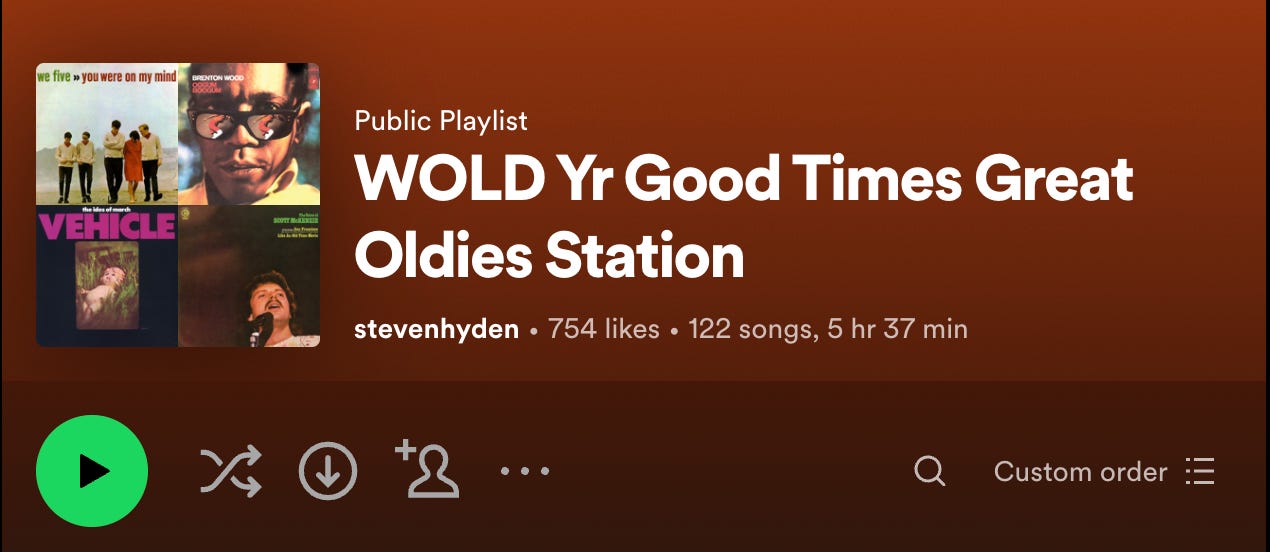
You have to put in some work to find these songs, but it’s worth it. Hyden’s piece has a link to a really good Spotify playlist that makes a strong starting point, and I linked to it below. YouTube has some compilations that aren’t quite right. You could also just click on some of the videos I posted and start going down rabbit holes. You might find a few clunkers, but you’ll also find some classic songs that maybe you heard once and have a vague memory of and will be delighted by all over again.

Whatever it is, it’s good music. And it deserves better than to be relegated to where the things and people we’ve forgotten go to when enough people can’t remember them.

This is the second piece I’ve written for my relaunched blog this week, and likely an example of something I’ll paywall in the near future. If you’re into more personal and eclectic stuff like this – or if you just like good music – consider subscribing on Patreon for just $8 a month. That will help me gauge whether people are into this stuff. Thanks!

We’re Talking About Joe Biden Completely Wrong

One of the hardest things about being of a certain age is that the people you once depended on start to depend more and more on you. They need more from you – more time, more energy, more help doing things they used to do without help, sometimes even more money.

Sometimes, having an elderly person who depends on you means making decisions. It means painful conversations and losses of things that they never thought they’d lose. Have you ever needed to take driving privileges away from an older person? Have you ever told them they have to move into assisted living, or it’s impossible for them to live independently without help?

Was it easy? Did they just hand over the car keys? Did they just shrug and say “I’ll start packing?”

They probably didn’t. They probably fought you, told you you were wrong, you were crazy, that they’re fine, that maybe they’ve slowed down a little and have a little trouble doing things, but that’s just part of getting old. They’re fine. And they don’t want to hear it again.

But you have to bring it up again, because they’re not fine. And before they drive into a tree or burn the house down or hurt someone, you’re going to have to resolve this. And on and on it goes, you push them to give up something, they push back that they don’t need to, and you argue and put your head in your hands and want to give up. You want to say “fine, let them drive off a cliff.” I tried. I give up.

But you don’t give up, because if you love someone and you see something about themselves that they don’t, you have a duty to keep telling them it’s there until they believe you.

Now take all of that stubbornness and denial and refusal to accept what the people around you have long ago accepted – and make it about the most important job in the world, a job that a lot of other people think only you can do, and that you believe if you don’t do it, we descend into a fascist hellscape.

That’s the problem with Joe Biden running for president again. It’s not that we’re asking him to give up the car keys or the house he lived in for fifty years. We’re asking him to give up being the most powerful human on the planet. And he doesn’t want to.

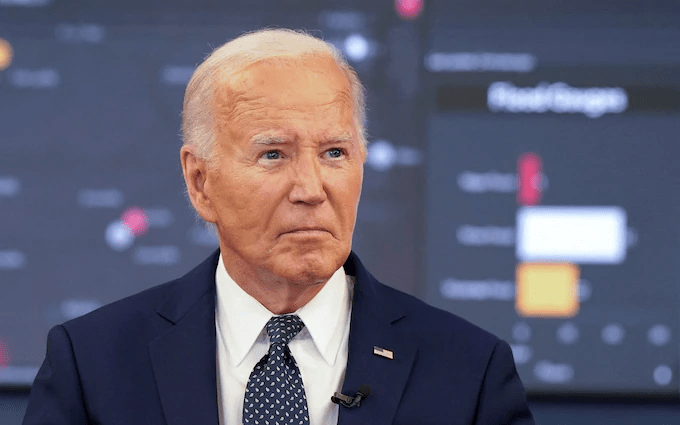
We’re talking about Joe Biden the wrong way. We’re talking about him like a political candidate, and not like a person. A person who is aging in a very public and ugly way. He is 81 years old, and will be 86 at the end of a second term. And nobody knows what that means for him, for his presidency, and for the country. But it’s hard to see it as anything positive or comforting. Not anymore.

Aging isn’t linear. It’s a slow decline in your faculties and abilities and memory and judgement and temperament. For a while, Biden could walk that line. It appears now that, at a minimum, he’s having trouble walking it. And his halting, quiet, feeble, mush-mouthed, incoherent, extremely painful performance in the June presidential debate against Donald Trump (who, it should be noted, is also mush-mouthed and incoherent, just much louder) proved it.

Biden’s defenders believe that him stepping aside and handing the nomination over to someone else, be it Vice President Harris or another Democrat, will be a disaster. They might be right, of course. They might also not be. They believe that Biden just had a bad night, that he was jet-lagged and feeling sick, that he was over-prepared and restricted by said preparation and let lag and sickness from “letting it rip.”

And again, they might be right.

But if you’ve watched someone you love age, you know that the Biden we saw during the debate is probably closer to the real Biden than anyone wants to believe. Yes, older people can have better days than their worse days. But Biden is only going to get older. Whatever is going on with him might ebb and flow, but it won’t get better. Aging doesn’t go in reverse.

It might happen again. Maybe even worse. And it might happen again when it’s too late to make a change without it seeming like chaos and a total lack of planning.

The conversation about Joe Biden stepping aside is one we should have had years ago. It’s one that should have been had based on reality, on the cruelty of aging, on the idea that one man does not define a political party, and on the knowledge that once you reach a certain age, things start to go wrong in ways that can’t be fixed and so maybe we should act before those things go wrong. It’s not ableist or ageist to see an extremely old man who is clearly breaking down in the way that almost all extremely old people do and point it out. To take the car keys away before he hits someone.

We are being told by Biden loyalists, social media influencers, and die-hards that all of this is just bedwetting and a waste of resources and does nothing but help Trump by ignoring his many flaws and horrors in favor of a media frenzy being goosed by the right wing oligarchs and rat-fuckers that run everything. That Biden is fine, he had a bad night, his appearances since then have gone better, and that we need to suit up, shut up, and get in line.

I reject all of this.

I reject the idea that the movement to push Biden to step aside is just more of the “but her emails” nonsense that sunk the Clinton campaign in 2016. Hillary Clinton’s emails were a minor story that was relentlessly exploited by the right wind media machine who had spent decades trying to destroy her. And the idea that the far right was actually concerned about information security is laughable given their unblinking acceptance of Trump keeping untold classified documents in the bathroom of his golf resort.

I reject the idea that criticism of the Democratic Party and of Joe Biden’s stubbornness is tacit support for Trump. It’s the exact opposite, it’s wanting the Democrats to put forth the candidate who has the best chance to win, and being extremely concerned that this might not be Biden, and even if it is, we should probably talk about it while we can.

I reject that anyone who is having serious doubts about Biden’s ability to win again, his age, and his state of mind are “bedwetters” who are panicking over nothing. The debate we’re having now is the debate that should have been had last year. It’s the sign of a healthy party that puts the good of the country over the ego of one man. We have one party like that already – the Republicans. Just because they will support their man no matter what he does, says, or inflicts on anyone else doesn’t mean we should do the same.

I reject the idea that Democrats wouldn’t support another candidate if Biden were to step aside. Sure, there would be crabbing and bellyaching over Biden leaving the field, but it’s ludicrous to believe that Biden diehards would stay home rather than support another candidate who was already lock-step in beliefs with Biden. Democrats did support a potential Biden replacement already: Kamala Harris, who 81 million people voted to step in for Biden should something happen. Well, something happened.

And I reject the ludicrous conspiracy theories that Biden was sabotaged by a rogue soundman at CNN, the excuses that he was in Italy 12 days before and was too tired to debate, and the self-serving demands to “unite or die.” If Biden thinks that the scrutiny he’s getting from his own party is bad, wait until Trump – who has been uncharacteristically silent the last two weeks – starts on him.

At the moment, the far right has been content to let the two Biden factions battle each other. But that won’t last much longer, and Biden is going to have to defend not only his record and presidency from the right, but his sanity and health and basic ability to make decisions. And it won’t be for the good of the country, it will be for the good of Trump – a man who puts nothing above himself.

Joe Biden is not like that. He is a man who puts country over self. Not many people are like that. But everyone gets older. Everyone loses the ability to do things they used to be able to do.

And everyone has loved ones that at some point will have to step in and make the decisions they might not be able to make anymore.

Because Joe Biden the person has reached the point where while it might not get worse for a while, it won’t get better. It never does.


This is the first post in what will be a relaunched TheMikeRothschild.com. For quite a while I’ve put it to the side while I work on bigger projects, but I’m missing the immediacy of regular writing. I hope to post twice a week, with one post more expressly political and/or fringe, and one a little more of a mix of things I care about and want to share. I hope you’ll share, subscribe, and do all the other things we ask readers to do these days. One post will be Monday or Tuesday, the other Wednesday or Thursday. I’ll develop more of a regular schedule as I go.

As part of relaunching the website and making it a viable way to use my time and resources, I’ve joined Patreon and will be asking readers to kick in $8 a month. Basically, a dollar a piece every month.

I know, everything is expensive and everyone wants your money. I get it. And I’ll keep everything free for now. But I truly hope that if you’ve ever gotten anything of value from something I’ve written, tweeted, or talked about in an interview, that you’ll chip in. And if you can’t, don’t worry about it in the least. Like I said, everything will be free until further notice.

Thanks for reading this far, and for everything!

(photo credit: Elizabeth Frantz/REUTERS)