Droning On and On

In 2016, Americans suddenly and somewhat hilariously became terrified of killer clowns. The creepy mirthmakers were spotted in South Carolina luring children into the dark woods, in Green Bay handing out black balloons, skulking around cemeteries in Chicago, randomly knocking on doors, intimidating residents, and approaching young girls in the open. The creepy clowns made their way to the UK, where they intimidated and pulled pranks on people in car parks and streets. One even ran for president.

Four years later, with the world on lockdown, boredom and fear walked hand in hand. That summer, full of tension and dread, people started to notice that every night in big cities, huge numbers of fireworks were going off in the middle of the night. Nerves were rattled and people were frustrated – and scared. Immediately, panic set in that this was a military exercise designed to rob us of our sleep, police activity designed to spur arrests, or even a Trump-ordered test to immunize the population into becoming accustomed to the sound of explosions and artillery.

Cut to 2024, another presidential election year involving Donald Trump. And sure enough, there’s another panic spreading through the plugged-in population over social media: drones. Thousands of drones, all the size of large cars, flying in straight lines and coming out every night (and only at night), hovering over population centers and military bases, and scaring the crap out of us. Is it a false flag to prepare us for alien invasion? A military exercise that Trump will use an excuse for martial law? An attack on American from Iran or China? Proof that nuclear weapons are being trafficked by nefarious forces and the government is desperate to find them? It’s now the Drone Panic of 2024, and it’s spread from news of drones over New Jersey to drones over everywhere.

Taken together, it seems like these three panics prove one of two things: either every presidential election now comes with a deep state engineered panic meant to distract and exhaust us in the face of the oncoming horror, or that Americans are nuts.

Of course, neither of these are the sole explanation. Societal panics are nothing new, and take place all the time fueled by new technology and collective unease. And many Americans, like people of every nationality, are conspiratorial and fueled by fear of what they don’t understand.

In the face of calls for the government to “do something” or “be more transparent” or “shoot them down,” it’s important to realize that what people are pointing out as drones are not actually drones.

They’re airplanes coming in for a landing, stars, planets, satellites, helicopters, optical illusions, deepfakes, hoaxes, and maybe a few commercial drones. They’re the same specks of light that have been in our sky for generations. There might be more of them now, thanks to outfits like Starlink and the revitalizing of commercial aviation post-lockdown. But at any time since the advent of the passenger jet, if you look up at night, you’re going to see something bright and flickering moving across the sky, or maybe appearing to hover, or maybe not moving at all. Isn’t it strange how the “drones” never seem to appear during the day? Or how countless SUV-sized craft are flying around and none have crashed, hit each other, or just stopped working over a busy city? Don’t expect answers from those panicking.

So why did the Great Drone Panic of 2024 happen, and what can we learn from it?

Panics rarely start over things that never happened, they start over isolated incidents that are blown massively out of proportion

In the case of recent past panics, they started with something real that spread over social media because it was equal parts absurd and terrifying. Clowns occasionally go about town in their clown getup, and scare the hell out of people in the process. (Incidentally, if I get a few new Patreon subscribers, I’ll post my own story about being at an event in Los Angeles with a clown that was very much not an event for clowns. It’s wild.) The fireworks panic was the same thing, at first – the nightly fireworks bombardments were real, but there was never any evidence that “the government” or “the cops” were behind them, other than unverifyable social media posts. It turned out that fireworks companies were desperate to unload excess product that wasn’t going to be used for 4th of July shows because of lockdown. No conspiracy required, just one made up to fit the facts.

Drones have become omnipresent, especially in war, but few people know what they really look like

Even just the term “drone” has scary connotations, especially for anyone who watched the Great War on Terror unfold live on cable news every night. It conjures up sinister forces using cryptic orders to fire missiles at weddings, killing you before you even know you’re a target. But drones can be anything – from hobbyist quadcopters to commercial drones delivering packages to lights flying in formation to create a nightly show to military grade missile carriers. Some drones are tiny. Others, like the Shahed 136 drones hammering Ukraine on a nightly basis, are 11 feet long, nearly the length of a compact car. There are over a million of them registered with the FAA, and there’s no doubt that at least a few of the “drones” are actually drones. Because there are so many different types of drones, it’s easy to look at something in the sky and tell ourselves it must be a drone. We don’t have to know what type of drone, or who launched it. It’s a drone. And drones can kill us.

Panic spreads because when we go looking for things, we find them

If you go outside on a cold night with the intention of seeing a drone, you’re probably going to see a drone. Why? Because why would someone go outside to see something and not see it? We like to find the things we’re looking for, and to not be disappointed. We want to be able to tell our friends and social media followers that we saw a drone, not that we saw a plane or a star. Ultimately, “I saw something” is a more compelling – and potentially viral – story than “I didn’t see anything.” That’s boring.

It’s a weird time where not much is happening

Americans have been on a relentless run of breaking news for years, and maybe no year more than 2024. We had stretches where absolutely insane and game-changing things were happening every day, and with Trump’s election, that seems to have calmed down. Yes, his cabinet nominations and goofy lawsuits are news, but they don’t the heady high-wire thrill of assassination attempts or last minute candidate changes. People are a little bit bored at the moment, and when people get bored, conspiracy panics start. When we lack danger and thrill in our lives, we find ways to make them up.

A lack of basic understanding about physics makes us turn the ordinary into the extraordinary

If you’ve ever driven across Los Angeles at night going north from LAX, you’ve seen a line of what look like floating blobs of light just hanging in the air. And because you’re at one of the busiest airports on the planet, you know they’re planes coming in to land, and not UFOs or drones or whatever. But if you’ve never lived near a major airport or flown into a big city at night, you might not be familiar with why descending airplanes look like they’re floating. So when you see it for the first time, your mind assigns meaning and danger to it. For the record, there’s a name for why descending airplanes appear to be floating. It’s an optical illusion called the parallax effect, It’s a difference in how the brain perceives rates of motion when moving, which is why closeup objects look to be moving quickly, while faraway ones look to be moving slowly or stuck. Parallax is a critical depth perception tool, not a deep state conspiracy. It’s basic physics – but a lot less entertaining and alluring than the unevidenced alternatives.

The “I know what I saw” fallacy

So many of the claims of drone sightings ultimately fall into some version of “I saw three lights in the sky forming a triangle. Triangles in the sky are UFOs. Therefore, I saw a UFO. And I know what I saw.” We aren’t interested in other explanations, such as the three lights being the lights on the wings and nose of a plane. We know what we saw. Except most of the time we don’t know what we saw, only that we saw something, and decided we knew what it was. Our brains have a remarkable ability to create stories out of things that didn’t happen, or that we only saw a glimpse of and filled in the rest. Maybe the best example of this is the numerous witnesses to TWA Flight 800 exploding who claimed they saw and then immediately heard a missile hit the plane, despite the laws of physics making this impossible. The people who told the FBI this weren’t lying, they were just convinced they saw something that they could not have experienced. And the more you tell them they’re wrong, the more they believe they’re being called a liar.

We’re just really into conspiracy theories right now

This might be the simplest explanation of them all for why drone panic hit so hard and so fast. Americans, just like all humans, are innately prone to pattern-seeking and making meaning out of randomness. But 2024 has seen the continuation of conspiracism and paranoia creeping into our everyday lives in a way that was never even possible just a few decades ago. Our political leaders and cultural titans spread disinformation the way a knife spreads butter. Even Donald Trump has stoked the drone panic, claiming without any evidence that the government “knows what they are” and telling his followers to shoot them down. Other influencers have claimed, also without evidence, that the drones are part of a desperate attempt to find a nuclear warhead, or a Russian disinfo op, or a secret coup plot. This used to be the stuff of rambling drunks at bars and your weird uncle at Thanksgiving. But it’s everyone now, and it’s everywhere we look. And that now includes the sky at night, once a place of awe and wonder, but now cluttered up with planes and satellites and ever-present low light blotting out the glory of the stars.

So what can we do to abate drone panic? Like all pushback against conspiracy theories, think micro and not macro. Stop sharing random videos that “saw a drone” flying somewhere, because absent other evidence, it’s not a drone. If you go looking for drones, expect not to find them. If you see a blob of light floating in the air, think about airports near you, not motherships and aliens. Get familiar with the stars and planets at night in your area, so you know what they are and are not. They’re pretty cool to look at.

And disabuse yourself of the notion that you are a player in a secret nighttime war between good and evil, being played out through drone swarms and viral panic. Take the opportunity to become acquainted with something bigger than your own life – in this case, the very cosmos that made us. It’s a hell of a lot more breathtaking than panicking over nothing.

Rothschild Central Banks – Syria’s Version

Extraordinary events are almost always catalysts for conspiracy theories – often providing more “acceptable” explanations for something that wasn’t “supposed to happen.”

And what could be more unexpected than the sudden and stunning collapse of the Assad regime in Syria? Rebel forces undid well over 40 years of rule in an offensive that took less than two weeks, and saw the Syrian armed forces collapse and even change sides. Watching it happen live was almost unbelievable, and many people indeed did not believe it. Or at least, they believed a different version of it. And of the many “more acceptable” explanations for what was going on in Syria, a familiar one that took hold early was that Syria was one of the only countries on earth without a “Rothschild Central Bank,” and the cabal finally took action to correct this half-a-century long oversight.

I’ve written extensively about the “Rothschild Central Bank” conspiracy theory, and why it’s incorrect on multiple levels. I spend a great deal of time on it in my book on the Rothschild banking family myth, Jewish Space Lasers.

But the situation in Syria is extraordinarily precarious and complicated. Even with Assad deposed, there’s no guarantee that the country will be able to develop a functional democracy, correct the previous regime’s human rights abuses, or not become a battleground for proxy groups and terrorist spillover.

With so many moving parts, it’s easy to imagine alternative stories emerging about how the Assad collapse was a Jewish plot, perpetrated by Israel and funded by the depravity of the Rothschilds, all to get their claws into yet another nation’s banking system. So with that in mind, here’s why the “Rothschild Central Bank” theory, and in particular its relation to Syria, is false and should be completely ignored.

There are no “Rothschild central banks”

A central bank is, by its very definition, a governmental entity. Central banks control money supply, print money, set interest rates, and manage the financial policy of a nation. And every country has one, other than a few tiny microstates that use the money of larger countries. In the US, we have the Federal Reserve, while the UK has the Bank of England, and so on. The nations of the European Union have individual central banks that are all members of the European Central Bank. Even North Korea has a central bank.

None of these central banks are owned by private investors, and certainly none of them are owned by the Rothschild banking family. Before the era of nationalized central banking, many wealthy banking dynasties owned shares of stock in national banks, including the Bank of England. But that era ended long ago, and for the Rothschilds, it saw a general decline in their wealth and power. Central banks are now owned and operated by their parent governments, not by decrepit tycoons in castles.

Why the Rothschilds in particular are linked to large scale ownership of central banks has a lot to do with their longevity and history. The family once did have business holdings all over the world, and had the ear of royalty and prime ministers. And the myth that Nathan Rothschild made so much money off the Battle of Waterloo that it allowed him to take control of the British money supply started in 1846 and has proven durable enough to fire conspiracism in everyone from French antisemites of the 1890s to Nazi propagandists of the 1940s to Alex Jones today.

But it’s not true, and never has been true. As I write about in Jewish Space Lasers, the myth of the Rothschilds and Waterloo spread decades after the battle, and we know for a fact that the family made little off the outcome of the battle itself – though they did make much of their fortune off loans and gold sales during the Napoleonic Wars.

The list of “Rothschild Central Banks” dates back to a 2012 blog post, and has been repurposed by countless bad actors and cranks, including finding a prominent place in the QAnon conspiracy theory, where it’s eagerly passed around by “truth seekers” who don’t understand how banks work. But why is Syria lumped into this nonsense? Haven’t its people suffered enough?

The Central Bank of Syria began operating in 1956, succeeding the previous French-run central bank that had administered the country since 1919. It didn’t retain its independence by keeping the Rothschilds out, it did because it was run by a brutal dictatorial family. And even its status as “non-Rothschild” varies depending on which internet meme you get your information from. Some cranks claim there are only three independent central banks in the world, others claim five, others claim nine. Sometimes Syria is on those lists, sometimes it’s not. Other lists have North Korea, Iran, Russia, or even Iceland as not being controlled by the Rothschilds – when in most cases, they’re controlled by repressive regimes. Or in some cases, like Iceland, they were nationalized due to financial crises.

All of this is lazy and nonsensical antisemitism. Blaming the Rothschilds for things going wrong in a country you support is the bedrock of anti-Jewish sentiment. Tyrants, cranks, crackpots, and conspiracy grifters have been doing it has been for millennia. If you’ve been a die-hard Assad supporter and you’re watching his regime collapse, it’s easy to point to Jewish power and control as the cause.

None of this means you’re a truth seeker or alternative journalist. It makes you a crank and an antisemite. The Rothschilds have no central banks, aren’t installing one in Syria, and have nothing to do with the bravery and tenacity of the Syrian opposition. They’re the real story, not the phone string pullers of meme-making nightmares.

To support my work on conspiracy theories, disinformation, and the people who spread them, check out my Patreon page, or my profiles on Bluesky and the website formerly known as Twitter. Thank you!

Who Was William de Rothschild?

The deaths of the eccentric scions of the wealthiest families in the world tend to make the news. And the more eccentric and wealthy, the bigger the news stories. While not especially eccentric, unless you count conspiracy theories, the death of Lord Jacob Rothschild in February was a major story. Even long-faded fortunes merit obituaries when one of their heirs dies – such as the death of Rockefeller heir David Kaiser in 2020.

On Wednesday, November 27th, another Rothschild heir, William de Rothschild, met an untimely end in a house fire in the Hollywood Hills. Naturally, there was a flood of stories about the elderly scion’s death and his apparently eccentric life full of classic cars and even possible hoarding, with the LA Times leading the way. The story seemed to confirm his identity, with neighbors talking about how he freely spoke of his status in one of the wealthiest families, and how he owned two properties on Lookout Mountain, one of the wealthiest streets in LA.

But a few days later there are no obituaries in the New York Times. There aren’t any stories about his philanthropy and largesse, or even reminiscences from other members of the Rothschild family. William de Rothschild simply vanished from the news.

There are a lot of reasons why that could be. His death broke on Thanksgiving, and during a frantic stretch of news when President-Elect Trump is nominating a clown car of conspiracy theorists and grifters to his new cabinet. William had little public footprint, and seemed almost totally unknown outside his neighborhood. Maybe it just wasn’t newsworthy past the first day.

Or maybe it’s because William de Rothschild likely had no actual lineage in that famous family, and wasn’t one of those Rothschild at all.

In the LA Times story, William’s identity as a member of the banking family comes entirely from neighbors. Certainly William has the trappings of wealth – the story talks of his love for classic cars, including a Porsche once owned by Michael Jordan, as well as busts of “great thinkers” in front of one of the two properties he owned on Lookout Mountain.

But just because someone says they’re a Rothschild doesn’t mean they are. And as I write about in JEWISH SPACE LASERS, my history of the myths and conspiracy theories about the family, numerous frauds and grifters have made hay off pretending to be a Rothschild, from Mar-a-Lago crasher “Anna de Rothschild” who was actually a Ukrainian scammer, to NYC art world grifter and investor “Paul-Kyle de Rothschild Deschanel.”

And while it’s hard at this point to rule out that William isn’t a distant relative or in-law who took the name, there’s also no compelling evidence he has any link to the family beyond him claiming to have one. And from what I’ve been able to piece together, both the Times piece and the stories that followed, which were mostly based on the Times, simply took the neighbors’ claims as truth.

To be clear, there is no “William de Rothschild” or any version of that name in the official Rothschild Archive’s genealogy, meaning William isn’t a direct relation to Mayer Amschel Rothschild or any of his ten children. (I reached out to a contact at the family Archive in London to confirm if William was a family member, and received no reply). There’s no reporting anywhere about anyone named William with a direct lineage to Mayer or his family, and keep in mind that this is one of the most well-known families in the world.

The only William listed in the Rothschild archive is someone who married into the family, the former husband of Lord Jacob Rothschild’s daughter Hannah. But William Lord Brookfield is an actual person, a screenwriter and producer who is also nearly two decades younger than the 87 years old given for William de Rothschild.

Or maybe he was 77. It’s hard to tell, because even as the Times story admits, property records for the two houses on Lookout Mountain give different ages for “William de Rothschild” as well as at least one different name.

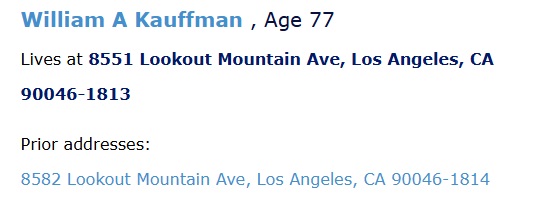
And there’s where things start to get even weirder. The initial press release from the LAFD about the fire gives the address as 8551 Lookout Mountain Road. Both property records and public listings for that property given the owner’s name not as William A. De Rothschild, but as William A Kauffman, Jr. This matches the CA Unclaimed Property website, which also lists William A. Kauffman as living in the house at 8551.

Such records are not always accurate, but this one has some clues that point the way toward it being correct, including one very big one: the ownership of two properties on Lookout Mountain, with the other being 8582.

Sure enough, 8582 Lookout Mountain lists a William A. Kaufman, age 77, as a former owner along with a “Wm Derothschild” and several other names. And Kauffman is also listed as a former owner of 8551 Lookout Mountain, where “William de Rothschild” met his unfortunate fate.

One of the names listed as an owner or the trustee of 8582 is Margaux Mirkin, the daughter of Budget Rent-a-Car founder Morris Mirkin and a minor celebrity in LA in the 1980’s who apparently once made an appearance on Lifestyles of the Rich and Famous.

There are plenty of other tangents to go down here – such as 8582 seeming to have a lot of former owners or residents, or William Kauffman owning what appears to be an office complex in Chatsworth, CA. But William Kauffman is a pretty common name, and a pretty thorough search didn’t turn up anything more about his life, much less his death.

I couldn’t find any biographical information on who he is or how he ended up on Lookout Mountain in a house fire. And I found nothing that corroborated the existence of anyone named “William de Rothschild” with a link to the Rothschild banking family.

At least one conspiracy blog thinks it uncovered a marriage listing for William de Rothschild and Margaux Mirkin, but again, online property records and genealogy listings are extremely inaccurate. It’s also not proof that “William” is a Rothschild, merely that he used the name at one point. And William de Rothschild has no social media presence, except for a few Twitter accounts that are obvious fakes, full of nonsense about the Illuminati and using the image of an Italian fashion designer for their profile picture.

And with nothing else to go on, conspiracy theories are a natural way to fill in the many blanks in this story. Blogs and social media posts are full of accusations that “de Rothschild” was in hiding under the name “Kauffman,” that he faked his death, that he was murdered by anti-Rothschild forces, that “Kauffman” was a master Mason, or that it took the LAFD 33 minutes to extinguish the fire due to ritual purposes. Even other folks named William Rothschild have been pulled into the mess, including an unfortunate resident of South Carolina whose image is being used by conspiracy theorists, despite looking 50 years younger than the fire victim.

All of this is typical of the nonsense spewed about the Rothschild family – even those who simply share the name. And at this point, without some other evidence or confirmation from the family archive, I’m pretty certain that whoever William A. Kauffman was, he might have used the name “de Rothschild” at some point, but he wasn’t related to Mayer Amschel’s descendants.

Not that any of the reporting on the fire cared to look. All of the stories about the Lookout Mountain fire, from Newsweek to the New York Post, relied on the initial LA Times story as their source. And the Times relied on neighbors’ testimony, a magazine found at the scene with “Wm. Rothschild” as its subscriber, and conflicting property records as evidence. This all points to nothing other than Kauffman using the name or claiming he shared lineage with the family. It also fits with other phony Rothschilds who have eventually been uncovered – they act the part by throwing money around, and because the Rothschild name has so much mythos and aura attached to it, nobody bothers looking into who the person actually is.

And I have no idea who William Kauffman was. I’m certainly not accusing him of anything untoward. It’s clear from the reporting that he was an elderly man, and may have had at least some trouble with hoarding according to reports after the fire. Why he used the name, when he started, or what caused the fire are all unclear right now. Was he a relative by marriage? A distant relation who played up his connection? Or did he simply pretend to be part of the descendants of “money’s prophets” for personal gain? I don’t know, and we might never know.

But whoever Kauffman was, it’s fairly clear that he wasn’t a Rothschild, or at least there’s no public record of him being one. I hope his family can find some peace in the year ahead.