I’m an independent journalist and author with an uncertain road ahead. To support my writing, please consider a paid subscription to my Patreon page, or you can Venmo me directly, @rothschildmd. Thank you so much!
I didn’t see President Trump’s appearance with state and local officials in Pacific Palisades on Friday, except for a few brief snippets I caught live on NBC as I was waiting to make an appearance to talk about LA fire conspiracy theories (yes, I did sprain my shoulder patting myself on the back there.)
What I did see was totally unremarkable for what we’ve come to expect from Trump over the last decade. It was hostile to the point of being uncomfortable to watch, bizarrely confrontational towards Governor Newsom and other California politicians, full of barely-coherent “science facts” about water and the giant imaginary spigots that it flows from, and studded with contradictory promises that residents will “get everything they want” and that residents will also get nothing unless the state implements pointless voter ID provisions.
One thing Trump made abundantly clear is the burning white hot hate he has for FEMA. After spending a huge amount of time on the campaign trial spouting insane misinformation about FEMA abandoning North Carolina after it was hit by hurricanes, he’s done the same with California. He claimed the agency is “not good,” corrupt, incompetent, and doing nothing for disaster victims. And he threatened to dissolve it and simply leave emergency recovery to the individual states – an act many pundits pointed out would disproportionately hurt the states that support him the most.
Naturally, he contradicted himself there as well, while also seeming to not know that FEMA is part of the government, claiming that “rather than going through FEMA, [emergency funds] will go through us.”
To be completely frank, as an Eaton Fire victim, I’m not paying one damn bit of attention to what Trump is saying about the fires. Trump doesn’t care what happened in Altadena, and all but ignored the Eaton Fire entirely. He doesn’t care that I spent Friday sifting the ruins of our house and shoveling the wreckage of the last 20 years of my life and the lives of my kids, an experience so strange and depressing that I’m not sure I can write about it more than I already have. I’d tell him about picking up burned baseballs only for them to disintegrate, or finding the charred metal tins that held the ash of the card games we played – but I can’t imagine he’d see anything in it for him.
We aren’t talking about Trump in our recovery. His pontificating about giant water spigots being turned on by the military and California dumping millions of gallons of water to protect an endangered fish are not helping anyone sort through the maze of forms and calls and meetings that confront us every day as we start the rebuilding process. His ludicrous sparring with Newsom isn’t ensuring residents get the mental and financial help they need. And when the TV cameras are off and the public’s attention has moved on, it won’t be Trump’s promises to gut FEMA that will be moving our community forward.
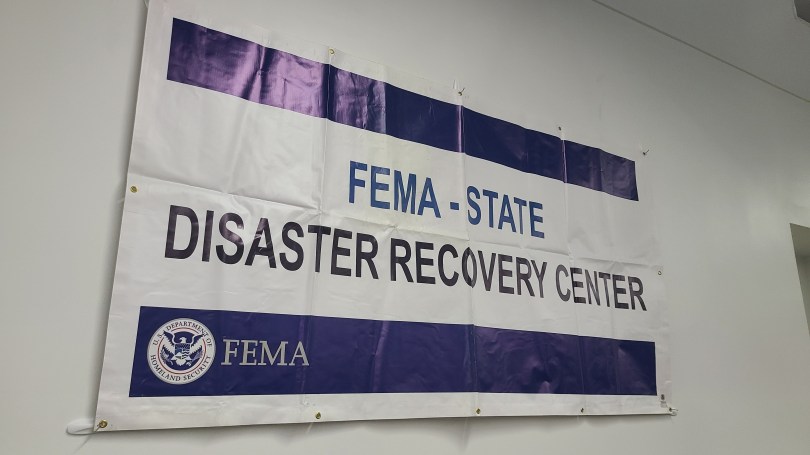
It will be the small army of workers and contractors we met with at a newly opened disaster recovery center in Pasadena today. On its first day in operation, built to replace a different recovery center, it seemed to be fully operational and ready to go. Table after table was run by people handing out forms for federal, state, and local departments – tax assessors, public works, mental health, hazardous materials abatement, critical documents. And more are coming, all ready to guide Eaton Fire victims through every aspect of the process of collecting insurance, ensuring safe removal of debris, and taking the first steps in rebuilding. They even had snacks.
And yes, FEMA was there. Along with representatives from many other federal agencies that our tax dollars pay for, and that make our lives better. The people that Republicans have been consistently attacking as lazy, overpaid, unqualified professional beggars who can’t get “real jobs” are offering a hand up to disaster victims at their absolute lowest.
They answered our questions, helped us fill out the forms we needed to fill out, walked us through who we needed to call, and reassured us that things will get done. The transition from rubble to home will go as fast as it safely can. I left with my head spinning, a bag groaning with forms and documents, and a better understanding of the complex process that lies ahead.
What a process it will be. Nothing like the recovery Southern California is about to undertake has ever been attempted. Two cities getting back off the ground after nearly 18,000 structures were annihilated in the second and third most destructive fires in the state’s history. It involves a mind-boggling amount of coordination and communication. Like most large-scale disaster responses, there’s no blueprint for what federal, state, and local officials are embarking on. Some of it has to be made up on the spot given the scale of the fires. And a lot of it is just a bunch of question marks at this point.
Naturally, this kind of massive and coordinated effort makes for a frustrating and confusing user experience – especially given how exhausted and dispirited the “users” are. Several times at the disaster recovery center, we got unclear answers, were told to go talk to a different agency that directed us back to the first agency, and got told things that either made no sense or contradicted other things we heard. Very few people were willing to give anything other than a ballpark estimate of when cleanup will really start and end, or when building might get going. We also got a lot of “we’re still figuring it out.”
Because they are. We all are. I’m figuring it out minute to minute and have no idea what comes next. And I don’t have the added responsibility of having thousands of employees and tens of thousands of burned out residents who need direction and answers and to know where to get a new drivers license. Much of this is still being figured out or legislated into existence. And when things go wrong, the shit will roll uphill, to the feds.
It’s not hard to see why. It’s always been easy to crap on the federal government. It’s especially easy to crap on FEMA, an agency that’s seen by the far right as both a cartoon villain constructing internment camps for patriots and as incompetent funnel for graft and failure.
But the people who were at the recovery center, from chaplains to volunteers to clerks to public employees to high-ranking officials to folks who’d come in from all over the country were doing their best. Mistakes and confusion are going to happen. We’ll figure it out because we have to, and we’re probably going to do it without the president’s “help.”
The road ahead for us is long, uncertain, and bound to be frustrating and painful. But there are tiny glimmers of daylights, and with enough help, just about anything can be accomplished. Except turning on the giant California water spigot, because that’s not real.
 Mike Rothschild
Another witness to what thousands in Southern California are experiencing. Thank you for sticking with being the witness for those of us at least one or two steps away from the victims of the fires are experiencing. May it make us all more compassionate and caring for all our brothers and sisters.