I’m an independent journalist with an uncertain road ahead. To support my work telling the story of the Eaton Fire and its aftermath, please consider a paid monthly subscription to my Patreon page. Thank you!
One of the reasons I started writing about conspiracy theories and fringe beliefs was that they exploited people at their worst times in the most craven ways. While human beings have been defrauding other human beings since the dawn of commerce; it’s gotten much more pervasive in the internet era. We are deluged with phony email scams, dodgy investments, medical products that don’t work backed by science that also doesn’t work, phishing and hacking attempts, and more. Our email inboxes are full of them, our phones ring off the hook with them, and they even leave their stupid ads on our mailboxes and car windows.
It made me angry then, and it makes me furious now. In my position at the center of a disaster, I’m seeing all the ways Eaton Fire survivors are being robbed, ripped off, exploited, and defrauded. We are the targets of every scheme and scam under the sun, and it’s time to call out the people doing this for what they are: despicable vulture scumbags, to borrow a phrase from my friend and Skeptoid podcaster Brian Dunning used about people selling pseudoscientific hardware to ALS sufferers.
Going through all of the ways these scumbags are trying to screw fire victims would take far too long and involve too much depravity for any one post. But the scammers started as the fires were still burning, and continue to find new ways to hound and exploit people dealing with the biggest disaster most will ever face. They know we have insurance money and little bandwidth or energy. And they think we’re easy targets.
Almost right away, the shady contractors came out. Even though rebuilding hasn’t really started yet, unlicensed contractors are seemingly everywhere, offering cut-rate prices to do work that costs much more – and probably getting ready to skip town once they’ve been paid with hard-won insurance money. Likewise, private debris removal companies promise to do the job faster than the Army Corps of Engineers, but instead do it unsafely and with half-full trucks designed to bloat out costs. When looking at contractors or debris removal, vet, vet, and vet some more. Ask for license numbers, references, and other information that will prove their worth. If they won’t give it, they don’t have it.
We’ve seen it before – the massive amount of fraud related to COVID relief and PPP loans, the bribes and schemes that infected the recovery from past fires, people claiming properties were destroyed when they weren’t, and identity theft related to FEMA grants and other government payments. Friends of ours had to deal with this exact issue, trying to apply for FEMA grants only to find out that the previous owner of their house had already done it. It’s despicable, and you want to ask yourself “who does this,” except a lot of people do. Even the idea of fraud can delay responses and waste time – we’re waiting on a second home inspection with FEMA because we suspected the first contractor to call us was fake, except they weren’t. We think?
If you think ripping off the government is bad (and it is), what about ripping off people donating to fire victims? Fake GoFundMe pages, often set up to look identical to already existing GFM drives, proliferated in the days after the fire. Some people found fake versions of themselves on Instagram promoting pages that would never send them a dime. Phishing scams targeted other GoFundMe pages, nearly wiping out tens of thousands of dollars in donations with a single phone call. Imagine your exhaustion and grief days after losing everything – you can’t tell up from down, and have so many calls to make and people asking you for information that you can’t discern the good from the bad. It’s sick, but it’s also the way predators work – pick out the weakest and slowest gazelle in the herd and wait for it to fall behind.
The glut of people needing new homes and the insanely tight housing market in LA has also opened the door for rental scams, with fake listings popping up on websites offering low rents for seemingly nice places, only to not have been placed by the actual rental company, and trying to get you to send them a deposit and the first month’s rent on a house that they don’t manage. Likewise, rental companies and landlords are engaging in old-fashioned price gouging, massively and illegally jacking up rental prices on properties that desperate families have agreed to rent.
And it can happen to you really easily. We were looking for apartments and had a couple of texts with one such company, only to find out from the actual rental company that it was fake. Fortunately, we decided to go look at the property on our own and realized that the number we’d been texting wasn’t the number of the rental company. But it’s very possible we could have gotten scammed – because we’re exhausted and trying to do a million things at once.
Of course, if rental scams and phishing emails are too complicated for you, you can always just steal stuff. Looting exploded in the first days after the fires, with gangs of thieves descending on abandoned homes to pilfer whatever they could. The national guard and local police were deployed to stop it, but in the first few days, many residents who hadn’t gotten evacuation orders or couldn’t leave stayed in their homes specifically as a show of force against looting.
Once the burn area was locked down, looters found other ways to steal, and now that the area is open again, they’ve taking to rummaging around burned homes looking for copper wire or breaking into surviving garages. Our neighbor’s garage was looted, and even our property looks to have been hit, since I found downed electrical wire moved around and stripped bare, along with an abandoned pair of shitty work gloves. I don’t know if they got anything of value, but I hope whoever tried got tetanus.
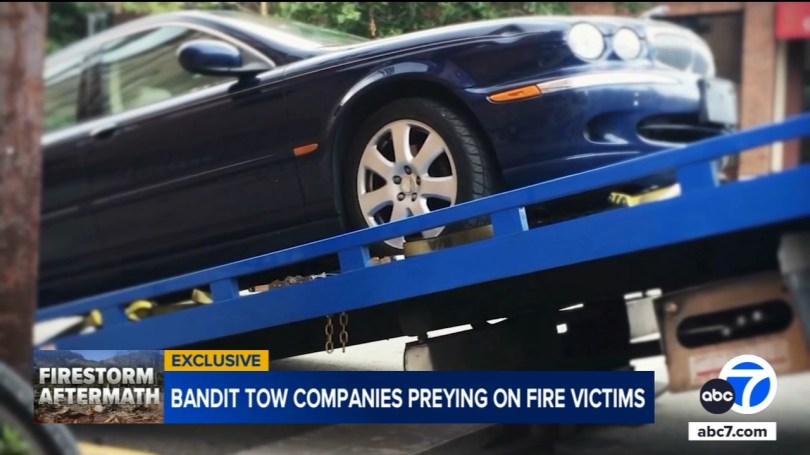
With little of value left to take, and most surviving homes either boarded up or inaccessible, thieves are getting more brazen in their attempts to rip off fire survivors. Just in the last few days, news broke of yet another fraud that had been going since the beginning: fake tow truck companies towing cars left behind by fire victims, then demanding huge sums of cash to release them. Some companies are going so far as to file liens on cars they’ve towed.
Again, despicable vulture scumbags.
Finally, there are the scams that aren’t directly related to the fire but that still are deeply hurtful and triggering. Few Altadena residents go through a day without getting at least one spam call from someone “in the neighborhood doing repairs” who wants to look at their nonexistent roof or plumbing. It’s likely these are just spammers going through lists, since it’s a waste of time to try to get money to fix a burned down home. But it’s still a pain in the ass and a reminder of what’s been lost.
So much, of course, has been lost. But we don’t have to lose our money along with our homes. I’ve been writing about scams and frauds enough to know some ways to combat them – don’t answer any phone call you don’t recognize, don’t open any email from a stranger with an attachment, and vet everyone you’re potentially working with. Any contractor who won’t give you a license number or references to speak to should immediately be reported, and any federal agency demanding information they don’t need, making you pay for something that your tax dollars cover, or promising you the moon in giveaways is a rip-off. Don’t wire money to strangers, run away from anyone wanting to be paid in crypto or through payment apps, and if something that should be free costs money, avoid it.
And Altadena residents are working together to watch out for each other. Advocates are going through neighborhoods and ripping down unwanted signs from potential scammers. We’ve all gotten very cagey about answering unwanted and unknown calls. We’re working together to vet contractors and helping folks get to places like the disaster recovery centers. And we’re speaking out to the media when we get victimized or find out about new scams.
But we’re still so vulnerable and exhausted. And the scammer will always get through – what could anyone have done to stop looting on the day after the fire? Who has the time or energy to research every single email and call and offer they get? How was I supposed to keep them from stripping the copper wire in my backyard? It’s not like I can take it with me. The bastards know we’re vulnerable and have gone through so much, and they’re ready to pounce at the first sign of an easy target.
The fire may have gone out, but the danger persists. I urge us all, myself included, to stay vigilant, keep our radar on high alert, and when in doubt, block and ignore anything that seems fishy or fake. Tell your friends, go to the authorities, and go to the press. We can beat the vulture scumbags if we work together and let them know we’re on to their bullshit.
 Mike Rothschild
I agree that this is horrible behavior. I have dealt with people who read obituaries in the newspaper, then rob the house of the family, or send letters claiming that the deceased owed them money, or that the bought the deceased’s car a week before they died.
Scammers and crooks descend on tragedy and try to take advantage of suffering and overwhelmed people. The only way to stop them is to be on guard, as Mike says, and to inform law enforcement. The scammers will gain from their behavior: They will receive free room and board in Hell.
I appreciate all these fire-related posts that help the rest of us understand your traumatic experiences. This post, though, is rage-inducing. I’m so sorry those soulless ghouls are causing additional pain and trauma. Thank you for sharing your experiences.