Eaton Fire #12: Despicable Vulture Scumbags

I’m an independent journalist with an uncertain road ahead. To support my work telling the story of the Eaton Fire and its aftermath, please consider a paid monthly subscription to my Patreon page. Thank you!


One of the reasons I started writing about conspiracy theories and fringe beliefs was that they exploited people at their worst times in the most craven ways. While human beings have been defrauding other human beings since the dawn of commerce; it’s gotten much more pervasive in the internet era. We are deluged with phony email scams, dodgy investments, medical products that don’t work backed by science that also doesn’t work, phishing and hacking attempts, and more. Our email inboxes are full of them, our phones ring off the hook with them, and they even leave their stupid ads on our mailboxes and car windows.

It made me angry then, and it makes me furious now. In my position at the center of a disaster, I’m seeing all the ways Eaton Fire survivors are being robbed, ripped off, exploited, and defrauded. We are the targets of every scheme and scam under the sun, and it’s time to call out the people doing this for what they are: despicable vulture scumbags, to borrow a phrase from my friend and Skeptoid podcaster Brian Dunning used about people selling pseudoscientific hardware to ALS sufferers.

Going through all of the ways these scumbags are trying to screw fire victims would take far too long and involve too much depravity for any one post. But the scammers started as the fires were still burning, and continue to find new ways to hound and exploit people dealing with the biggest disaster most will ever face. They know we have insurance money and little bandwidth or energy. And they think we’re easy targets.

Almost right away, the shady contractors came out. Even though rebuilding hasn’t really started yet, unlicensed contractors are seemingly everywhere, offering cut-rate prices to do work that costs much more – and probably getting ready to skip town once they’ve been paid with hard-won insurance money. Likewise, private debris removal companies promise to do the job faster than the Army Corps of Engineers, but instead do it unsafely and with half-full trucks designed to bloat out costs. When looking at contractors or debris removal, vet, vet, and vet some more. Ask for license numbers, references, and other information that will prove their worth. If they won’t give it, they don’t have it.

We’ve seen it before – the massive amount of fraud related to COVID relief and PPP loans, the bribes and schemes that infected the recovery from past fires, people claiming properties were destroyed when they weren’t, and identity theft related to FEMA grants and other government payments. Friends of ours had to deal with this exact issue, trying to apply for FEMA grants only to find out that the previous owner of their house had already done it. It’s despicable, and you want to ask yourself “who does this,” except a lot of people do. Even the idea of fraud can delay responses and waste time – we’re waiting on a second home inspection with FEMA because we suspected the first contractor to call us was fake, except they weren’t. We think?

If you think ripping off the government is bad (and it is), what about ripping off people donating to fire victims? Fake GoFundMe pages, often set up to look identical to already existing GFM drives, proliferated in the days after the fire. Some people found fake versions of themselves on Instagram promoting pages that would never send them a dime. Phishing scams targeted other GoFundMe pages, nearly wiping out tens of thousands of dollars in donations with a single phone call. Imagine your exhaustion and grief days after losing everything – you can’t tell up from down, and have so many calls to make and people asking you for information that you can’t discern the good from the bad. It’s sick, but it’s also the way predators work – pick out the weakest and slowest gazelle in the herd and wait for it to fall behind.

The glut of people needing new homes and the insanely tight housing market in LA has also opened the door for rental scams, with fake listings popping up on websites offering low rents for seemingly nice places, only to not have been placed by the actual rental company, and trying to get you to send them a deposit and the first month’s rent on a house that they don’t manage. Likewise, rental companies and landlords are engaging in old-fashioned price gouging, massively and illegally jacking up rental prices on properties that desperate families have agreed to rent.

And it can happen to you really easily. We were looking for apartments and had a couple of texts with one such company, only to find out from the actual rental company that it was fake. Fortunately, we decided to go look at the property on our own and realized that the number we’d been texting wasn’t the number of the rental company. But it’s very possible we could have gotten scammed – because we’re exhausted and trying to do a million things at once.

Of course, if rental scams and phishing emails are too complicated for you, you can always just steal stuff. Looting exploded in the first days after the fires, with gangs of thieves descending on abandoned homes to pilfer whatever they could. The national guard and local police were deployed to stop it, but in the first few days, many residents who hadn’t gotten evacuation orders or couldn’t leave stayed in their homes specifically as a show of force against looting.

Once the burn area was locked down, looters found other ways to steal, and now that the area is open again, they’ve taking to rummaging around burned homes looking for copper wire or breaking into surviving garages. Our neighbor’s garage was looted, and even our property looks to have been hit, since I found downed electrical wire moved around and stripped bare, along with an abandoned pair of shitty work gloves. I don’t know if they got anything of value, but I hope whoever tried got tetanus.

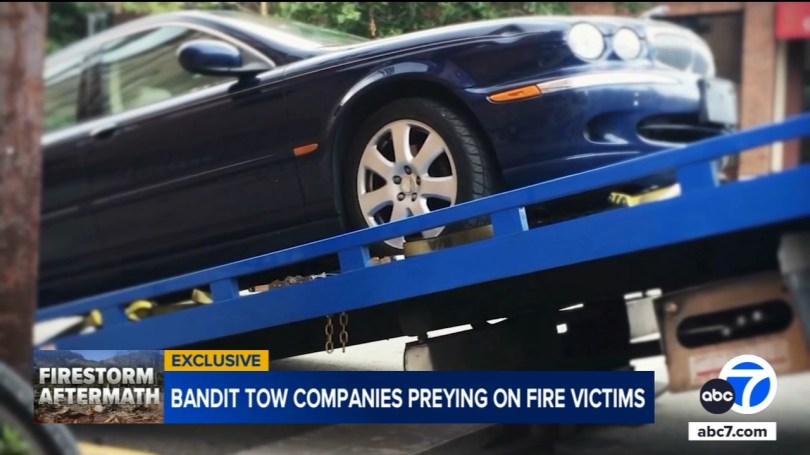
With little of value left to take, and most surviving homes either boarded up or inaccessible, thieves are getting more brazen in their attempts to rip off fire survivors. Just in the last few days, news broke of yet another fraud that had been going since the beginning: fake tow truck companies towing cars left behind by fire victims, then demanding huge sums of cash to release them. Some companies are going so far as to file liens on cars they’ve towed.

Again, despicable vulture scumbags.

Finally, there are the scams that aren’t directly related to the fire but that still are deeply hurtful and triggering. Few Altadena residents go through a day without getting at least one spam call from someone “in the neighborhood doing repairs” who wants to look at their nonexistent roof or plumbing. It’s likely these are just spammers going through lists, since it’s a waste of time to try to get money to fix a burned down home. But it’s still a pain in the ass and a reminder of what’s been lost.

So much, of course, has been lost. But we don’t have to lose our money along with our homes. I’ve been writing about scams and frauds enough to know some ways to combat them – don’t answer any phone call you don’t recognize, don’t open any email from a stranger with an attachment, and vet everyone you’re potentially working with. Any contractor who won’t give you a license number or references to speak to should immediately be reported, and any federal agency demanding information they don’t need, making you pay for something that your tax dollars cover, or promising you the moon in giveaways is a rip-off. Don’t wire money to strangers, run away from anyone wanting to be paid in crypto or through payment apps, and if something that should be free costs money, avoid it.

And Altadena residents are working together to watch out for each other. Advocates are going through neighborhoods and ripping down unwanted signs from potential scammers. We’ve all gotten very cagey about answering unwanted and unknown calls. We’re working together to vet contractors and helping folks get to places like the disaster recovery centers. And we’re speaking out to the media when we get victimized or find out about new scams.

But we’re still so vulnerable and exhausted. And the scammer will always get through – what could anyone have done to stop looting on the day after the fire? Who has the time or energy to research every single email and call and offer they get? How was I supposed to keep them from stripping the copper wire in my backyard? It’s not like I can take it with me. The bastards know we’re vulnerable and have gone through so much, and they’re ready to pounce at the first sign of an easy target.

The fire may have gone out, but the danger persists. I urge us all, myself included, to stay vigilant, keep our radar on high alert, and when in doubt, block and ignore anything that seems fishy or fake. Tell your friends, go to the authorities, and go to the press. We can beat the vulture scumbags if we work together and let them know we’re on to their bullshit.

Eaton Fire #11: Should I Stay or Should I Go?

I’m an independent journalist with an uncertain road ahead. To support my work telling the story of the Eaton Fire and its aftermath, please consider a paid monthly subscription to my Patreon page. Thank you!


We all want to believe that if a disaster struck, we’d know what to do both during and afterwards. And we want to believe we’d have the fortitude to stick to it, never waver, and present rock-solid certainty to those struggling with difficult decisions.

But life does not present itself with easy opportunities for “rock-solid certainty” and never wavering. Existence is not an ad for low-risk investment vehicles. Instead, it’s a series of decisions that need to be made with little information and even less certainty. We do the best we can with what we have, try to consider the variables and the unknowns, and then ultimately we roll the bowling ball and hope it knocks down enough pins.

The immediate danger of the Eaton Fire has passed. And the smoke smell and toxic ash seemed to have abated, at least if you’re not directly in the fire zone. But the hard decisions from the fire are only getting started. And they will have repercussions for fire survivors for decades to come.

The most important and far-reaching choice we have to make is to either rebuild a new home once our land is cleared, or sell the land and start over somewhere else. Both choices are fraught with variables, unknowns, hidden traps, opportunities, and risks. Each presents a vision for a certain life that will unfold over the next years and decades – and a different life not lived. Only one road can be taken, and the choice has to be made in deep uncertainty.

Many Altadena residents immediately declared they were rebuilding. For someone who has spent their entire life here, and maybe lived in the house one of their parents grew up in, the choice to stay is easy – even if rebuilding itself is not.

Likewise, some people will sell their land at the first chance they get. At least some plots of land in Altadena have already gone up for sale. The first land sale sparked a flurry of posts on local social media and text chains – a lot that was listed for $450,000 and went for well over that after getting dozens of offers. It was owned by an investor who wasn’t interested in trying to rebuild, and got out fast – likely leaving a lot of money on the table by not waiting for debris removal.

But it’s not that easy for most of us.

Each choice has legitimate merits. Staying and rebuilding means that you get a say in your house’s design and building. It means sticking with your community, revitalizing your town, being there for your neighbors. It means ensuring that charming neighborhoods and modest streets aren’t taken over by glass boxes and nightmare condos. And it means that when this is all over, you’ll have stuck it out and seen the process through to the end. You’ll own a new home in one of the most coveted locales in America.

Leaving, of course, means being in a house sooner. And given the absurd expense of building and the cost of real estate in the Los Angeles area, it probably entails a bigger house on more land. It means getting out of whatever temporary arrangement you’ve cobbled together. You might not be able to fight the glass boxes and nightmare condos anyway, and if you leave, you don’t have to try. And it might mean walking away with a big pile of cash to go with your new house, depending on your insurance payout and land sale price.

Each choice begs considering the other one. Rebuilding will be a time-consuming and expensive process, one that might not be done for two to three years. Hiring an architect is expensive, and with a limited supply of qualified architects and designers, they’ll be able to charge top dollar for their services. Building a house from the ground up based on a bespoke design is hugely money-intensive, particularly in Los Angeles. It will be even more outrageous given the demand for materials and crews that 15,000 homes will require, between Altadena and the Palisades. The numbers I’m hearing are outrageous – anywhere between $600 and $1,000 per square foot. All told, if Trump’s tariffs jack up prices on materials, demand sends labor costs skyrocketing, and permitting drags on, you could be looking at about $1.5 million to built a “modest” 1,500 square foot house. There’s a reason why most folks I’ve talked to feel everyone in either fire zone is underinsured. We probably are.

And yet…the choice to take the money and run is fraught as well. For one, it feels like a betrayal of the community we love so much and the neighbors we’ve gotten to know so well. There are few guarantees of finding something you want in the place you want to go, unless you’re simply willing to roll the dice and move anywhere you can find a house – which is a choice nobody with kids is likely to make. People who have started over somewhere else will always be those people who left town when things got rough. And they will be outsiders and strangers in a new place. They will probably have to tell the story of their loss to every person they meet in their new town. And once you leave the L.A. real estate market, getting back in is almost impossible.

The timing is also crucial, and intricate. Selling your land for top dollar means waiting for it to be cleared. But that could take the better part of 2025, and real estate prices will only go up. Housing supply, at least in the L.A. area, isn’t going up to compensate – meaning staying in the LA area will be that much harder. If you wait to make the decision to finally not sell and start building, you might miss out on hiring an architect and getting the permitting going. The longer you wait, the longer it will take. Likewise, you don’t want to rush in and hire the first people you meet with – this is a recipe for regret and scammery.

If you dither on your choice, it might be too late to make the choice you want to go with. But how can anyone help but wait, given the variables and unknowns ahead? What if you start building and can’t afford it? What if you sell and hate where you moved to?

All the choices are right and wrong.

Many people intent on rebuilding are trying to even the odds a little, banding together with neighbors to form collectives to ensure design and construction consistency, and to lower costs. Some architects are proposing the old school catalog model, where you pick a home design from a menu of designs and try to drive down costs through mass production. Fraudulent contractors and shady developers are being named and shamed on Altadena social media. And meetings, webinars, and town halls are a constant in town, as we all share info and buck each other up for the road ahead.

We are taking part in a lot of these efforts, and as of now, rebuilding is our intention. But wavering is part of the process too, and we spend a lot of time wavering. How could we not, given the time and expense involved? Who wants to wait years to build a house to live in? Who wants to spend this much time and money on something they could just buy somewhere else? And the risk of another fire will always be top of mind, meaning there’s the distinct possibility a new house will never feel entirely safe.

I won’t shame anyone for selling and moving somewhere they can start over. Okay, I might shame someone who sells to an obviously ill-intended developer. But honestly, people have to do what’s right for them. The community and neighborhoods matter, but ultimately, nobody is going to have your best interests in mind more than you.

And yet, staying seems right. Why leave if you don’t want to?

Hopefully, we all make the right choices with the right information at the right time. Because we only get one chance to get it right, and there are no re-dos either way. No pressure, right?

Eaton Fire #10: Some New Normals

I’m an independent journalist with an uncertain road ahead. To support my work telling the story of the Eaton Fire and its aftermath, please consider a paid subscription to my Patreon page. Thank you!


It’s almost starting to become normal.

A month and a few days have passed since the Eaton Fire burned down our house, destroyed our possessions, and gutted our entire neighborhood. And time is doing the thing that time does – putting distance between us and a traumatic event, and making the past recede further into the…you know, past.

Life as a fire refugee is just becoming “life.” For those of us who lost our homes, things are settling into something that, while not anything close to what life was like in the before times, is also quite not the frenetic chaos of the first few weeks.

Certainly, whatever your experience is right now is individualized for you. Some people are still bouncing from living space to living space, others might be settled for a few months or a year, and everyone has a slightly different status to their various applications and insurance questions. But the high-wire adrenaline frenzy of the first days has subsided, and most of us are squarely in the places we’re going to be in for the foreseeable future.

The schools are open and kids are back in them, even if some aren’t in exactly the same ones. We’re sharpening our routines, shaving minutes off new routes, and finding shortcuts. The light in our new bedroom almost looks like the light in our old bedroom, and if you close your eyes it almost feels like home. The sore throat we still get after being in the fire zone too long doesn’t sting as much. Maybe we’re used to it, or maybe the smoke has actually cleared.

The constant rumble of ServPro trucks and utility vehicles and cranes is losing its novelty. The shock of going into the fire zone and seeing the burned out homes and businesses doesn’t hit quite as hard once you’ve been there a few times. We aren’t suddenly remembering as many lost items as we once were, and some of them are starting to be replaced. We’ve almost gotten used to using our current address as our address, as opposed to the address of the ash pile that used to be our forever home.

Even the ash piles themselves aren’t looking quite so forlorn. Power poles are starting to go up, damaged trees are getting cut back, and the EPA is starting to complete Phase One debris removal on a few properties. The work crews are busy, the trees are getting marked, and the ruins are looking a bit less ruined. The bulldozers aren’t warming up, but they’re probably in the same time zone, at least.

The feeling of despair and exhaustion and overwhelm that pervaded Pasadena even a few weeks ago seems to be lightening up. Over the weekend, the shopping areas and restaurants seemed utterly jammed, with people everywhere and little parking to be found. There wasn’t as much glum, and more people simply enjoying meals or shopping or whatever it is people not living in constant state of trauma enjoy.

And this is probably the time when this should be happening for most folks. If you didn’t lose your house, or at least lose access to your house, things have been normal for a while for you. You’ve moved back home (if you evacuated at all), and are going back to your life as it used to be and as it will continue to be. Your normal never really changed, except for a few days when you might be worried. You cleaned up the mess in the fridge, rebooked appointments you canceled, and are just doing your thing. Normal.

Of course, “normal” is just a word people throw around between crises. Fire survivors in LA are still spending virtually every waking moment navigating the overlapping mazes of insurance, rebuilding, mortgage forbearance, architecture and design, government assistance, debris removal, finding new living space, and dealing with financial and logistical hurdles. And we’re doing it while going back to work, sending our kids back to school, and trying to make long-term plans. We’re making the appointments we cancelled while on the run. We’re trying to figure out summer vacations. Disaster recovery has become something we do alongside our regular lives, as opposed to the focus of our existence the way it was in January. Giveaways of stuff are ending, GoFundMe pages are bringing in almost nothing, and you’ve probably told everyone you’re going to tell about the disaster at this point.

So yeah, normal. And also not normal at all.

Living in the overlap between the ordinary and the extraordinary is exhausting. Where do you balance it? How do you take time out of meetings and calls for your job to have meetings and calls with FEMA? How do you plan a business trip or a vacation knowing you might get the call from the Army Corps of Engineers that those bulldozers are finally here? How do you plan for the future when so much of that future depends on factors out of your control and deadlines that haven’t been set?

In some ways, the “going back to work and pretending everything is fine” phase of the Eaton Fire is harder than the early days. Back in mid-January, life was moment to moment. Nothing mattered except finding the next meal, making the next call, dealing with the next call. There was no future except ten minutes from now. The world was ending. It’s why people watch movies about the apocalypse, and not movies about the cleanup and rebuilding after the apocalypse. After the Walking Dead isn’t as alluring as The Walking Dead.

Now we have to live the lives we were living before the disaster, while also building what our lives will be afterwards. The zombies are gone, and someone needs to clean up the corpses and build some new towns. The expectations are different. The pace is slackened. The coffee not overflowing. So it’s normal.

But not really at all. And not for a long time to come.

One of the things I most enjoyed in Altadena was walking our dogs at night. The air was clear, the streets quiet and dark, and you could hear birds singing rather than horns honking. Sometimes you’d even hear the hooting of an owl. The other night I took the dogs out for one last pee, and sure enough, I heard an owl hooting. Maybe it was the same owl, displaced from its home the way we are from ours. Or maybe it’s a different owl. But hooting is hooting, and for just a brief moment on a cloudy night portending rain, things were a bit like they used to be.

So here’s to normal, whatever it looks like and whenever it comes.

Eaton Fire #9: Debris Removal for Dummies

I’m an independent journalist with an uncertain road ahead. To support my work telling the story of the Eaton Fire and its aftermath, please consider a paid subscription to my Patreon page. Thank you!


I’m not an engineer or homebuilder, but I know that the first thing you need to do to physically build a new house is clear away what’s on the land where you want to put the house. Clearing away empty desert or weeds on a vacant tract of suburban land is fairly easy. Clearing away the charred and toxic debris left behind by thousands of burned houses in a densely packed neighborhood is a bit different. And more time-consuming. And more expensive.

As the shock of thousands of Californians losing their homes starts to wear off, our thoughts turn to rebuilding. But we can’t even start the process of building new homes until we clear away the gloppy ash of our old ones. Debris removal has been one of the biggest drivers of conversation and confusion among fire victims, and I’m going to write a little bit about my current understanding of what is supposed to happen and when it supposedly will be done.

Partially, I want to give folks a window into the exacting level of detail and decision making that goes into clearing away the remains of a once-treasured home. And partially I just want to make sure that I understand it myself. Because once it’s done, it’s done. So bear with me.

Debris removal for the Eaton and Palisades Fires is divided into two phases. Phase One is fairly easy. The EPA, working under the auspices of FEMA, sends teams out to each property to find and remove any material that’s obviously toxic. So that’s lithium ion batteries from electric and hybrid cars, half-melted electronics, potentially toxic paint, propane, asbestos, solvents, cleaning fluid, pesticides, or hazardous chemicals. This is free, paid for by our tax dollars as one of those Things Government Just Does. And you can’t opt-out, because you don’t have the right to endanger your neighbors.

Once Phase One is completed on a cluster of properties, Phase Two begins. This is more complicated. The actual debris of the house has to be cleared. This includes the ash, any standing walls or structures, and any other remains. So those beautiful brick chimneys that represent the only surviving parts of hundreds of houses? The staircases that lead to nowhere? The half-destroyed walls that once held families and celebrations and milestones? The Army Corps of Engineers bulldozes them and takes them away.

But you have to opt-in by filling out a form called ROE – Right of Entry. And it’s free – except not really, because the Corps is contracting with LA County, and LA County will bill your insurance, which will likely just send you the money to pay for it until you hit the limit of what your insurance pays for. Naturally, each insurance company is a little different, and the form asks you multiple questions that don’t have easy answers. Should you have your foundation taken out? Some people say yes, others say no. I said yes, because I don’t especially want to build a new house on the quite likely warped foundation from the last one. But do I really know if that’s the right call? What about your trees? Your driveway? Do you get to be there for it? We’re all finding out in real time.

Once you’ve filled out the form, you wait for the county to prove you are the property owner – theoretically this prevents apartment dwellers whose units burned down from approving the removal of the entire building. Then you wait for the removal to be approved. Once that’s done, the Corps calls you within a few days of the removal, and on the designated day, they show up with their equipment, wet down the ash so it doesn’t blow away, and get rid of everything, down to six inches of topsoil. Just like that, your debris is a hole in the ground. Like it was never there at all. And you can watch it if you want.

If you opt out by not filling out an ROE, you have to hire licensed contractors and get the proper permits and approval from the county to do it yourself. This is a considerably more time-consuming process than just filling out a form, and if the debris removal isn’t done correctly, you have to pay to have it done again. It seems to me like just opting in and waiting for the Corps to call you. But maybe some folks don’t want “the government” to have “right of entry” on their “property.” I wouldn’t know, I like it when government does things my taxes pay for.

For the first few weeks, the process of debris removal was just whispered about, with much of the information conflicting. Was it LA County doing it? The state? The feds? The Army Corps of Engineers? People were hearing different things because it’s kind of all of those. It’s a big job. With the “who” and “how much” settled, the conversation shifted to “when will it be done?”

And again, it’s complicated. Phase One and Two will be running concurrently, with some parts of the burn area onto Phase Two while others are still on Phase One. Hundreds of crews will be working, and they’re going to try to work neighborhood by neighborhood, so they don’t have to drive all over the place. Each house likely will take somewhere between two and ten days, and the entire process will be done in about a year, with some outliers taking another few months. So if you get lucky, you could be in construction on a new house by the fall of 2025. But it will take as long as it takes to do it safely,

As convoluted as the process sounds, it’s really not very demanding. And I take some comfort in the fact that there’s a delineated process, the people doing this know how to do it, and they’ve done it before.

What’s less comforting is that while FEMA, the EPA, and the Army Corps of Engineers are gearing up for a MASSIVE debris removal and abatement project; the federal government is being gutted and “efficiencied” by President Trump, Elon Musk, and their army of weirdos.

Trump has already talked about eliminating FEMA, his pick to run the EPA wants to gut it, and the president continued his ludicrous beef with California by ordering the Corps to open two dams that are nowhere near LA to “give LA” the water it needs to fight the fires that are already out. So none of that is great for our debris removal prospects. To say nothing of the president’s threats to impose massive tariffs on Canadian lumber and mass deportations, which would all drive up the already absurd cost of building a new home in the Los Angeles area.

It’s impossible to tell whether Trump’s threats and Musk’s unhinged self-appointed jihad to cut government spending to ribbons will impact the cleanup and rebuilding in LA, but it’s hard to think it won’t. Will it be slowed down? Will resources and removal be auctioned off to the highest bidder? Will FEMA and the EPA be replaced by homeowners rolling up their sleeves and taking a big huff of toxic air?

Nobody here needs this right now. Nobody needs more uncertainty and doubt piled on top of the uncertainty and doubt we’re already feeling. Yes, there’s a process for debris removal, but none of us have gone through it before, and nobody has done it at this scale. So while we have answers to some of our questions, we have just as many questions left to answer. Until then, we’ll wait for our phone calls and hope the bulldozers come quickly and efficiently so we can start our new lives.

It’s not ideal, but it’s our life now.

Eaton Fire #8: Wandering Through Macy’s

I’m an independent journalist and author with an uncertain road ahead. To support my writing, please consider a paid subscription to my Patreon page, or you can Venmo me directly, @rothschildmd. Thank you so much!


If you live in Pasadena, the time around New Years Day is one of the highlights of the year. A few days after Christmas, fans from two different out of-town college football powerhouses come into the Pasadena area for the game on January 1st (or the 2nd, if the 1st is a Sunday), along with tens of thousands of families who are staking out claims to watch the Rose Parade. From Christmas to New Years, the town seems to be taken over by folks in matching sweatshirts, RV’s finding space anywhere they can, the ubiquitous white Tournament of Roses cars, bleachers going up on Colorado Boulevard, and the sense that something special and unique is about to happen.

Now picture something like that, something that you can just feel in the air and see on the faces of everyone around you, people from out of town and natives alike – except it’s the worst possible thing you can imagine. It’s not a parade and a football game, but devastation and trauma and dislocation and fear. A city once famous for celebrating the new year and for its mansions and contributions to science is now a literal and figurative dark cloud. Pain hangs in the air like stale smoke and sadness.

The Eaton Fire devastated over 9,400 structures and killed 17 people in Altadena. But it has done far more than cause considerable physical damage. The mental weight is enormous and crushing for Pasadena, the city that sits just south – and at times intertwines with Altadena to the point where one side of the street is Altadena and other side of the street is Pasadena. People are almost paralyzed with grief and uncertainty. If there’s a parade, it’s one of utility trucks and lime green ServPro cleaning vehicles and bulldozers. And if there’s a football game, nobody is paying attention.

Every trip out to run basic errands, procure replacements for lost items, or just get something to eat reveals countless other people going through their own personal version of the disaster. And every single person’s experience is a little bit different, but also the same.

This week, we went out to start building the rudiments of a new life while attempting to wrap up the old one, and found no escape from our unwanted reality. At lunch, the gentlemen on one side of us had clearly come from across the country to help deal with the emergency, while the women on the other side were comparing their losses. The restaurant, like every other restaurant around Pasadena’s busy shopping nexus, seemed quiet and half-empty.

The grief was at the mattress store where the man in front of us, who had been sleeping in his car, needed to replace a pillow that had absorbed too much soot and ash to be safe. At Macy’s, we wandered around in a daze, looking at various things without the ability to decide on which of them we needed, or what we had originally owned. Once something is gone, it’s hard to remember what it was. You never thought about it. It was just there. What brand of comforter do you own? Do you even remember buying it?

It’s everywhere and in everything. A woman was on the phone in Macy’s talking clearly about her burned out house and organizing a rally devoted to not selling land to developers, while another woman outside Macy’s was on her own phone clearly saying “my house burned down on the 8th.” Hey, my house burned down on the 8th too! We’re house burning down besties!

The jeweler’s house burned down. The bakery owner’s house burned down. The preschool director’s house burned down, along with the preschool. The church where we got married wasn’t burned out, but dozens of its parishioners were. And the synagogue where I once went to Yom Kippur service is a charred husk.

Even those who still have houses are living with brutal uncertainty, particularly in hard-hit neighborhoods like mine. Imagine still actually having a home and all your stuff, but simultaneously needing to rent an apartment and buy everything you already own because you have absolutely no idea when you’ll be able to go back. Or if what you have is safe. Or if the water and power on your block will ever go back on. The financial toll is enormous, and the uncertainty is crushing. What’s worse, having no home or needing two?

If you want an inkling of how traumatized Pasadena is due to the fire, hang out at the Post Office. Altadena used to have a post office, but along with the pizza place and thrift shop next to it, the post office is gone. To get your mail, you go to the main Pasadena post office, where you’re sent to a table outside to give them your address. Then you stand there and wait, as address after address is called out. The street names are familiar because they’re the ones that have been hit the hardest – a mail call where the soldiers whose names are called are already gone. There were several on my street, and many more on the streets just around me. It was deeply depressing, and also, there was no shade and sitting on a curb hurts because I’d been sleeping on an air mattress for days.

Some people have no mail. Some people have a mail carrier who’s out on their route, so they get to do it all over again. And some folks can’t get their mail since they lack the proper ID, like the woman in front of me who was picking up the mail for her business owner husband, but wasn’t actually him. Very few people are talking, and those who are talking are simply comparing what they’ve lost and who else they know that was burned out. What else would you talk about?

A thick haze of grief has settled over Pasadena. Maybe over all of LA, given the magnitude of the Palisades fire as well. I haven’t talked much about it given that it’s outside of my experience, but if it’s anything like Eaton, all of the westside is stumbling around in a daze, trying to figure out who they know that doesn’t have a home anymore. The air reminds you of it. The seemingly constant din of sirens reminds you. We got an Amber Alert on our phones and collectively crapped ourselves as a community. This is not sustainable or healthy.

Where does all this trauma go? How do we get back to living something resembling the lives we used to have before this? When can we just hang out with friends and do stuff with our kids and catch a ballgame without playing wildfire bingo with our losses? Forget about asking when our debris will be cleared (6 months? A year? 18 months?) or when we’ll have new homes (two years? Three years? TBD??)

Maybe it’s time to ask when we’ll stop walking around like we’ve got lead weights on our feet. It’s hard to imagine it will be anytime soon.