Eaton Fire #7: A Visit to the FEMA Camp

I’m an independent journalist and author with an uncertain road ahead. To support my writing, please consider a paid subscription to my Patreon page, or you can Venmo me directly, @rothschildmd. Thank you so much!


I didn’t see President Trump’s appearance with state and local officials in Pacific Palisades on Friday, except for a few brief snippets I caught live on NBC as I was waiting to make an appearance to talk about LA fire conspiracy theories (yes, I did sprain my shoulder patting myself on the back there.)

What I did see was totally unremarkable for what we’ve come to expect from Trump over the last decade. It was hostile to the point of being uncomfortable to watch, bizarrely confrontational towards Governor Newsom and other California politicians, full of barely-coherent “science facts” about water and the giant imaginary spigots that it flows from, and studded with contradictory promises that residents will “get everything they want” and that residents will also get nothing unless the state implements pointless voter ID provisions.

One thing Trump made abundantly clear is the burning white hot hate he has for FEMA. After spending a huge amount of time on the campaign trial spouting insane misinformation about FEMA abandoning North Carolina after it was hit by hurricanes, he’s done the same with California. He claimed the agency is “not good,” corrupt, incompetent, and doing nothing for disaster victims. And he threatened to dissolve it and simply leave emergency recovery to the individual states – an act many pundits pointed out would disproportionately hurt the states that support him the most.

Naturally, he contradicted himself there as well, while also seeming to not know that FEMA is part of the government, claiming that “rather than going through FEMA, [emergency funds] will go through us.”

To be completely frank, as an Eaton Fire victim, I’m not paying one damn bit of attention to what Trump is saying about the fires. Trump doesn’t care what happened in Altadena, and all but ignored the Eaton Fire entirely. He doesn’t care that I spent Friday sifting the ruins of our house and shoveling the wreckage of the last 20 years of my life and the lives of my kids, an experience so strange and depressing that I’m not sure I can write about it more than I already have. I’d tell him about picking up burned baseballs only for them to disintegrate, or finding the charred metal tins that held the ash of the card games we played – but I can’t imagine he’d see anything in it for him.

We aren’t talking about Trump in our recovery. His pontificating about giant water spigots being turned on by the military and California dumping millions of gallons of water to protect an endangered fish are not helping anyone sort through the maze of forms and calls and meetings that confront us every day as we start the rebuilding process. His ludicrous sparring with Newsom isn’t ensuring residents get the mental and financial help they need. And when the TV cameras are off and the public’s attention has moved on, it won’t be Trump’s promises to gut FEMA that will be moving our community forward.

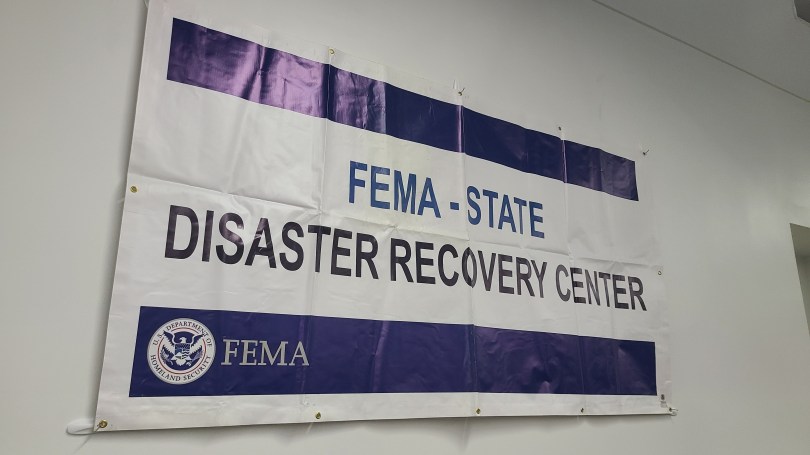
It will be the small army of workers and contractors we met with at a newly opened disaster recovery center in Pasadena today. On its first day in operation, built to replace a different recovery center, it seemed to be fully operational and ready to go. Table after table was run by people handing out forms for federal, state, and local departments – tax assessors, public works, mental health, hazardous materials abatement, critical documents. And more are coming, all ready to guide Eaton Fire victims through every aspect of the process of collecting insurance, ensuring safe removal of debris, and taking the first steps in rebuilding. They even had snacks.

And yes, FEMA was there. Along with representatives from many other federal agencies that our tax dollars pay for, and that make our lives better. The people that Republicans have been consistently attacking as lazy, overpaid, unqualified professional beggars who can’t get “real jobs” are offering a hand up to disaster victims at their absolute lowest.

They answered our questions, helped us fill out the forms we needed to fill out, walked us through who we needed to call, and reassured us that things will get done. The transition from rubble to home will go as fast as it safely can. I left with my head spinning, a bag groaning with forms and documents, and a better understanding of the complex process that lies ahead.

What a process it will be. Nothing like the recovery Southern California is about to undertake has ever been attempted. Two cities getting back off the ground after nearly 18,000 structures were annihilated in the second and third most destructive fires in the state’s history. It involves a mind-boggling amount of coordination and communication. Like most large-scale disaster responses, there’s no blueprint for what federal, state, and local officials are embarking on. Some of it has to be made up on the spot given the scale of the fires. And a lot of it is just a bunch of question marks at this point.

Naturally, this kind of massive and coordinated effort makes for a frustrating and confusing user experience – especially given how exhausted and dispirited the “users” are. Several times at the disaster recovery center, we got unclear answers, were told to go talk to a different agency that directed us back to the first agency, and got told things that either made no sense or contradicted other things we heard. Very few people were willing to give anything other than a ballpark estimate of when cleanup will really start and end, or when building might get going. We also got a lot of “we’re still figuring it out.”

Because they are. We all are. I’m figuring it out minute to minute and have no idea what comes next. And I don’t have the added responsibility of having thousands of employees and tens of thousands of burned out residents who need direction and answers and to know where to get a new drivers license. Much of this is still being figured out or legislated into existence. And when things go wrong, the shit will roll uphill, to the feds.

It’s not hard to see why. It’s always been easy to crap on the federal government. It’s especially easy to crap on FEMA, an agency that’s seen by the far right as both a cartoon villain constructing internment camps for patriots and as incompetent funnel for graft and failure.

But the people who were at the recovery center, from chaplains to volunteers to clerks to public employees to high-ranking officials to folks who’d come in from all over the country were doing their best. Mistakes and confusion are going to happen. We’ll figure it out because we have to, and we’re probably going to do it without the president’s “help.”

The road ahead for us is long, uncertain, and bound to be frustrating and painful. But there are tiny glimmers of daylights, and with enough help, just about anything can be accomplished. Except turning on the giant California water spigot, because that’s not real.

Eaton Fire #6: Desolation Row

I’m an independent journalist and author with an uncertain road ahead. To support my writing, please consider a paid subscription to my Patreon page, or you can Venmo me directly, @rothschildmd. Thank you so much!


I’m wiping my house off my shoes.

As I ran yet another sanitizing wipe over my New Balance 990’s – now the only pair of shoes I own – it struck me that I was removing particles of what used to be the house I thought I’d spend the rest of my life in.

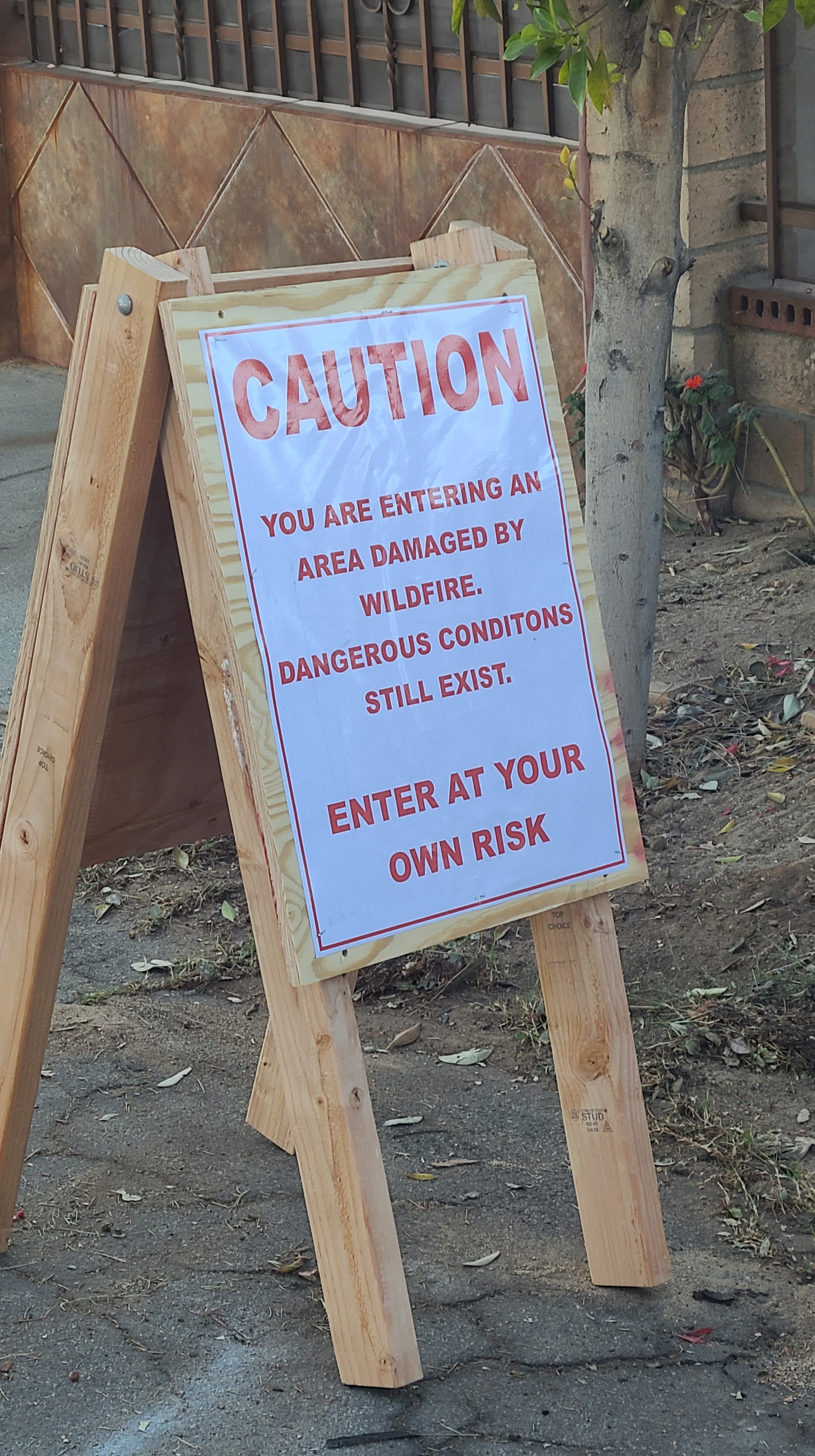
We’d been told in no uncertain terms that the ash left by the fire was toxic. It was likely full of microscopic residue from melted plastic, exploded propane tanks, and whatever happens to electronics when they burn real good. While we haven’t started sifting through the rubble, we did take our first direct look at what used to be our house, after driving through some of the other parts of Altadena where houses and businesses used to be. And it was a punch in the gut, just as we knew it would be, and just as it’s been for thousands of families burned out by the LA fires.

To pick up where we left off, we got back to Pasadena from the Central Coast on Wednesday night. Right away, Pasadena seemed different. It was quiet, still, and reeked of a fireplace that’s been left smoldering too long. The fires are almost entirely contained, but the air smells of soot, stale smoke, and char. It feels gritty – if air can, indeed, feel gritty. And there are firefighters and utility workers and tree surgeons and county officials everywhere. Just in the few minutes it took to go from the freeway exit to where we’re staying, one truck zoomed by with its lights and sirens blaring, and we saw at least two others. Sirens seemed to be constant.

It was better in the morning, at least in terms of air quality. Not in terms of exhaustion, dislocation, anger, and malaise. That’s not better. Morning doesn’t work miracles. Finally, after a day spent in the customary fashion of trying to get a dozen things done at once and accomplishing maybe three, we decided to head out to see the house. We’d tried twice before we evacuated, but couldn’t get close. The fires were still burning. The air was at its grittiest. But that was two weeks ago. It wasn’t time then. It was now.

I’ve never been in a war zone, but I’ve seen a lot of them on TV. Altadena might not look like an actual war zone, but it certainly looks like one on TV. It has the distinct patina of newsreel footage of Dresden after its February 1945 firebombing, or a BBC remote from Baghdad after an IED went off in front of a market. Massive stores, gutted and hollowed out. Homes reduced to crumbled plaster and charred wood. And just for good measure, armed soldiers in the streets in the form of National Guard members, assault rifles at the ready, there to prevent looting. The city looks like it’s been the subject of a strategic bombing raid, with some homes and shops untouched, and others destroyed.

We drove past the homes of our neighbors and friends, now just empty shells with melted cars in front. But nobody was home. Indeed, nobody was out anywhere in Altadena, except for a few other folks taking pictures of their burned out homes, sitting on their curb muttering, or talking to the utility workers that have suddenly become ubiquitous in the Pasadena area. Our street was once bustling with folks walking their dogs, kids on bikes, hikers on their way to or from the mountains, or families out for casual strolls. Now it was empty. Silent. It was just us and the gritty air and our dread over seeing the ruins of our forever home and at the long road ahead.

A particularly apt line from Bob Dylan started careening around my head:

And the only sound that’s left/After the ambulances go
Is Cinderella sweeping up/On Desolation Row

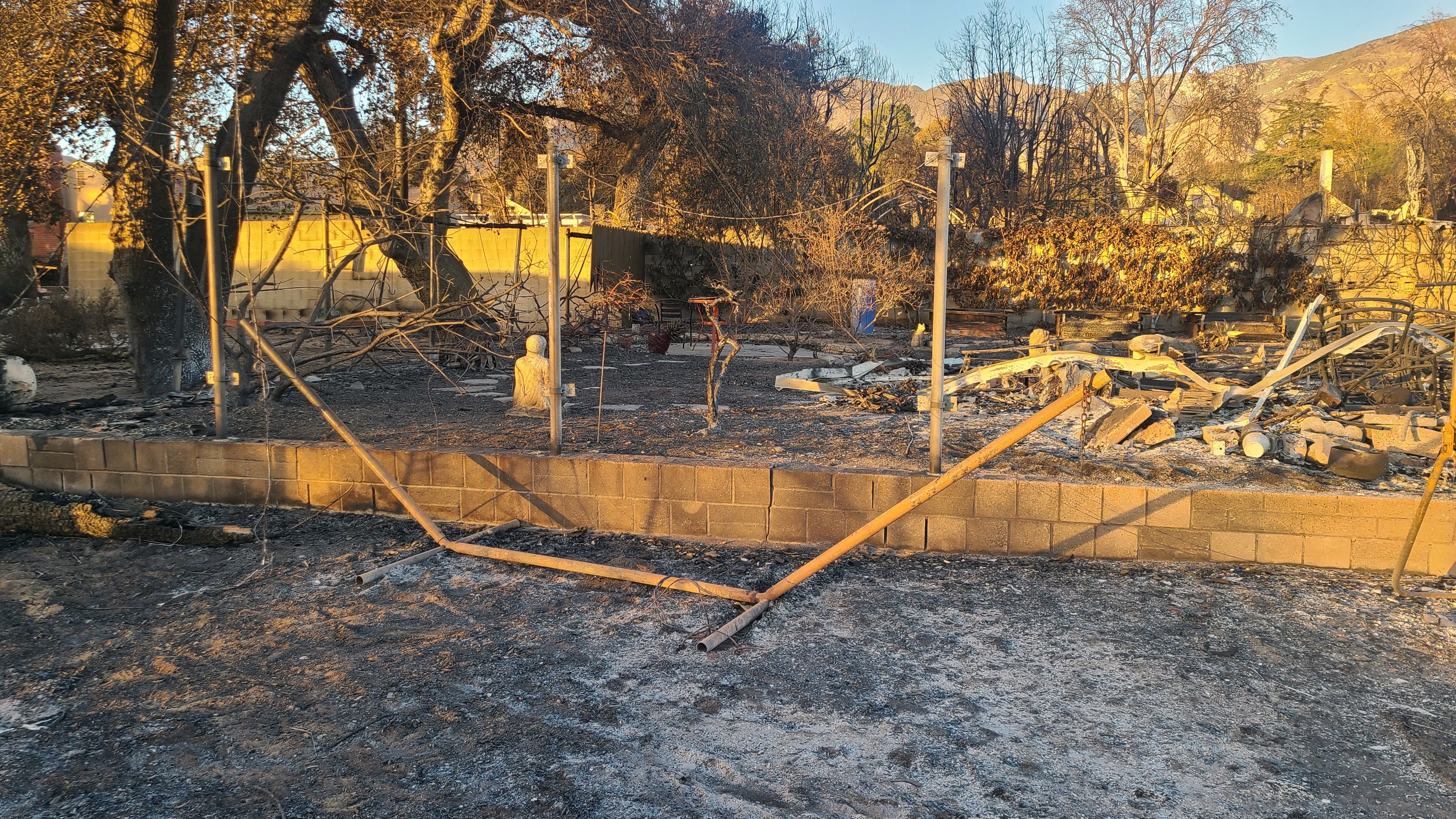
Finally, we drove up to the house. It was unrecognizable. The coral tree in the parkway was dead. The lantana plants in the front yard, usually bursting with purple flowers this time of year, were charred twigs. The wisteria that covered the fence between us and our wonderful neighbors to the south was gone. We could see through to the house behind us, through a wooden fence that no longer existed, that delineated the backyard of a house that no longer existed.

Nothing can prepare you for this. Nothing should have to. We got out and slowly walked up the driveway, taking pictures because we needed them for insurance and to remember. Close up, you can start to see the ephemera of a life, but it’s burned and scattered, decontextualized and in the wrong place. The springs from the sofa, but nothing else. The TV, only recognizable from the bracket that attached it to the wall. The washer and drier, tossed and charred. Our basketball hoop, crushed by the falling garage door from the garage that was totally annihilated.

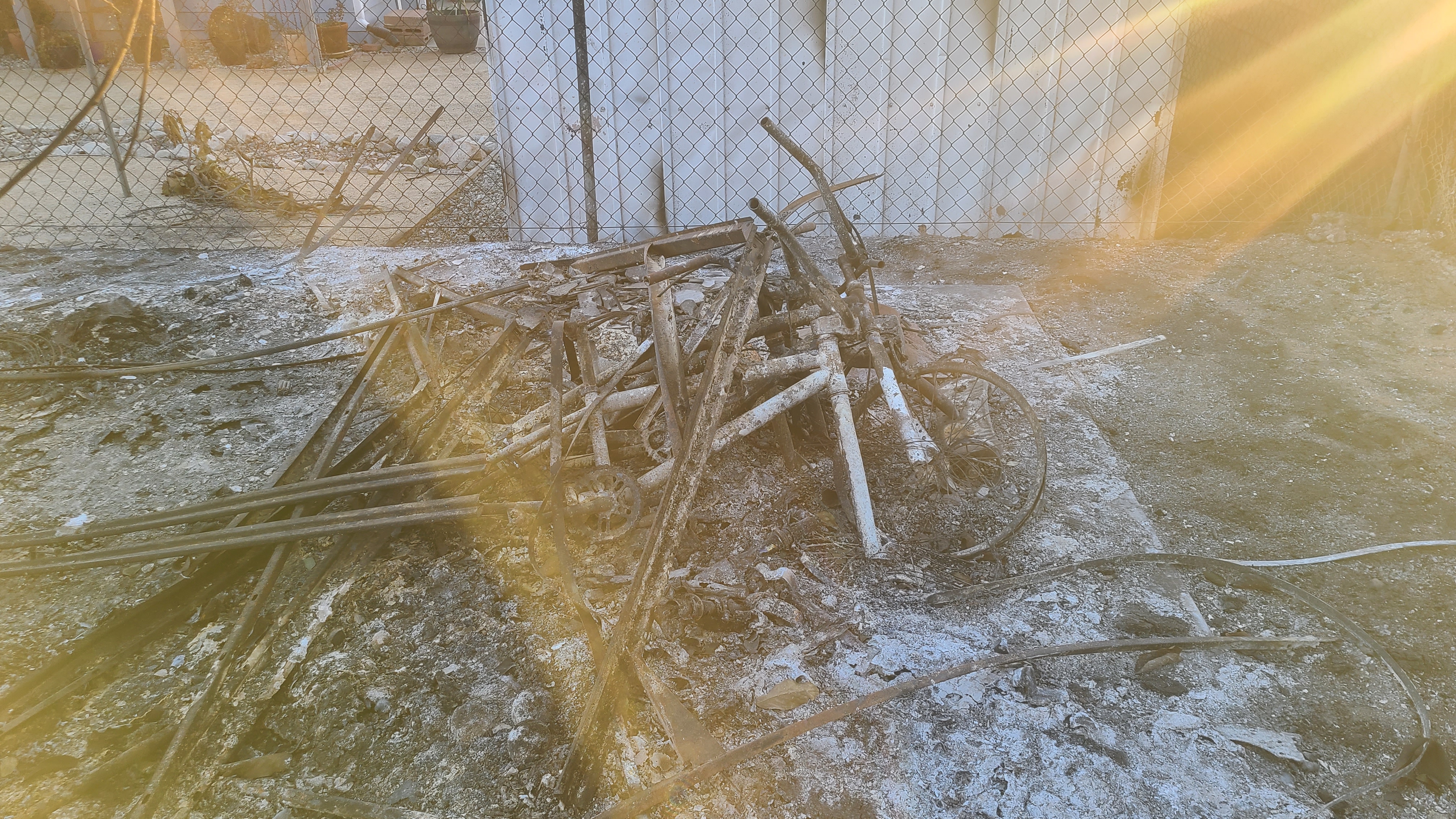
We probably shouldn’t have, but we walked the ground. Through the yard, up to the edge of the front porch, down the north side of the house, once nearly impassable due to rose bushes. We moved slowly, trying to take it all in – with no real urgency, because the clock had stopped ticking weeks ago. When it was time to go into the backyard, there was no need to open the gate to the back, the gate we’d prop open so the kids could ride their bikes or race their RC cars. We could just walk through the giant hole in it. It was a truly ugly sight. We saw dead and melted avocados on the grown, the skeletons of patio furniture, bits of glass and nails, and random crap too burned to identify.

A few metal things could be identified, but not salvaged – the base for our Christmas tree stand, the skeleton of the hammock I got for my birthday one year that I used to lie in the early morning sun and listen to podcasts, the kids’ bikes.

Taking the advice of smarter people, we didn’t touch anything. That will likely happen today, Friday. It’s supposed to rain soon, and we want to get into the ruins and sift before it turns into sludge. So we got some free PPE from the County and the Red Cross, and will go play scavenger in our own stuff. I doubt we’ll find anything, but you never know. One neighbor found a Christmas ornament of ours that survived, a piece of Polish pottery that somehow made the trip from the attic to the burning ground without shattering. There have been some other nice stories about people finding wedding rings and inspirational signs and things. But it looks bad, and if we find anything, it’ll be a nice surprise.

It’s even more desolate at night, a neighborhood once bustling with families and love that’s now unlivable. No light, no movement, no people. The standing houses are yellow tagged – they were spared but not habitable for the moment. And it’s going to be that way for months, most likely. Nobody knows when the disaster abatement is going to start, when the wreckage will be removed, and when anyone is going to be able to even start rebuilding. Or how much it will cost, or who will have the financial capability to do it. It’s a complete mystery, and until it’s solved, all that will remain is the desolation.

When we got back, I wiped my house off my shoes and went inside.

Eaton Fire #5: Hard Lessons

I’m an independent journalist and author with an uncertain road ahead. To support my writing, please subscribe to my Patreon page for as little as $5 per month, or Venmo me directly, @rothschildmd. Thank you so much!


When this post goes up on January 22nd, it’ll mark two weeks since we lost our house and everything in it in the Eaton Fire. We think the house went up in flames some time around 8:30 AM, and with it, any semblance of a normal life that we’d have for at least the next few years. It happens fast.

By coincidence, it will also mark our return to Pasadena after fleeing up the central coast. We’ve been in constant communication with our friends and neighbors, but for various reasons – mostly that we had nowhere to go – we stayed here. It’s beautiful, we’ve seen the ocean every day, the people are nice, and the air is clear. But it’s time to go home, or at least to what we’re deciding home is going to be.

So things are in a period of transition, during a larger period of transition. It’s a good time to take stock of everything that’s happened since the fire – both the good (spending time with family, getting to talk to Anderson Cooper) and the bad (the whole “we lost our house and everything in it” thing).

Taking inventory is one of the things you have to do during a disaster – one of the many things clogging up our grand to-do list. For this post, I want to take a different kind of inventory. Not of the stuff that burned, though we will have to do that. But of the things I’ve learned in the last two weeks. The hard-won, mostly unwanted lessons that come with a communal and personal tragedy like this. I detest the idea that “everything happens for a reason,” but I do believe that wisdom can be gleaned from adversity – and boy has this been some adversity.

We are capable of bearing the unbearable – this has been the hardest two weeks of my life. Harder than my mom dying and getting COVID in the same span of time. A dozen times during this fortnight I’ve felt like I was about to break, close to the edge of madness, wanting to just crawl in a hole, or utterly dreading just getting out of bed. But I didn’t break, I didn’t fall off the edge, I didn’t crawl in a hole, and I eventually got out of bed. This is absolutely terrible and I hate it, but I’m here, we’re getting through it, the lists are getting whittled down, and we’re taking baby steps toward a new home. Two weeks ago I never would have believed I could do this. I’m doing it.

The unthinkable can happen to anyone, even you – I never believed we were in a real danger zone for fire. Nobody in our neighborhood did. Then it happened, and within a day, we were scattered. Those people on the news scrambling for their lives, cramming their meager possessions in their cars, literally begging strangers for help, or left destitute and destroyed might not be in faraway countries or cities one day. They might be your friends, your neighbors, or you. Have mercy and grace for those left crushed under the wheels of climate change and disaster capitalism, because any of us could be one of them.

The good people outnumber the bad – I can count on one hand how many people have mocked my misfortune or turned their nose up at us. And I will never be able to count the folks who reached out, donated in some way, lent a hand, or asked what we needed. The same goes for every LA fire survivor. The world cares, and while “lol nothing matters” style nihilism might score points on Twitter, it’s not real life. People have been extraordinarily kind. Strangers have given us money and opened their homes, companies I have never heard of are giving away massive quantities of goods to the people of Altadena, and the outreach and concern for the plight of our town has been global. Good people are everywhere, and being a good person is still important.

People will want to hear your story, but tell it on your terms – I’ve been extremely vocal about what happened to us, and I will continue to be. People need to be reminded this happened, that it’s real, and that they can’t just look away. I’ve spoken on cable news and radio, and to strangers in my hotel lobby. But other people might not be ready to tell their story, particularly children, who are struggling horrifically under the weight of the loss and trauma. Everyone who went through this gets to choose how and when they do it, or if they do it at all. It’s helped me tremendously, but that’s just me. Don’t expect lurid details and entertainment on demand from survivors simply because you wish it.

Someone else winning is not a loss for you – I’m thrilled any time I hear of a house in Altadena that made it. Many did, though some might not be livable. I don’t feel any jealousy or feeling like I got screwed by their survival. We’re all stronger when our community thrives, and the more people who weren’t burned out is fewer people who have to start over. Their wins are our wins. This isn’t The Apprentice.

Take a few minutes to figure out what you’d grab in a disaster – We took a lot of irreplicable stuff, but missed some things that can’t be replaced, at least not easily. It never occurred to us to make a list of what we’d grab if an evacuation order came down. It doesn’t have to be a big deal, just a discussion you have with your family. What matters, how accessible is it. The stories I’m hearing of the priceless items people left as opposed to the useless crap they took are wild. Just take a second and think about it. Hopefully, you’ll never need to think about it again.

That new spot you want to check out? Check it out now – Altadena was becoming a hub of small businesses and shops, many of which had only opened in the last few months. And many of them are already gone, before we had a chance to get there. There was no urgency, no reason to go now as opposed to a more convenient time. Life is uncertain, and the place you’ve been meaning to go to might not be there when you get around to going to it. Don’t wait.

If a customer calls to cancel a service because they lost their house, don’t tell them to “have a great rest of your day” – Come on, man. Read the room.

Disaster vultures will smell blood and pounce – I’ve been inundated with spam calls about contractors in my area inspecting homes – joke’s on them, since I don’t have one. I’ve heard horror stories about FEMA fraud. Law firms with no experience in disaster litigation are holding meetings with free food and hotel rooms. Cleaning services are jacking up prices and massively overselling. And real estate developers are already pushing out low-ball offers to traumatized residents. The sharks are out. Some are just taking advantage of the situation, others are straight up con artists. Protect yourself and your community, share information, stay skeptical, and don’t rush into anything you can’t undo.

There’s nothing a determined community can’t do – Sociologists have lamented the loss of Americans feeling a sense of community. While many American cities become more siloed and walled off, and the bonds of friendship and workplace camaraderie fall away, we’re experiencing the opposite. We’re already rebuilding. We are meeting and planning on how to keep the vultures and speculators out, keep our diversity, and restore our cultural heritage. Nobody is giving up, we’re banding together. You can band together with your neighbors too, well before a tragedy like this forces you to. People used to look out for the people on their block and in their apartment building. We can do that again.

That’s it from the Central Coast. The next update will come from Pasadena, where these hard-won lessons will be put to the test.

Eaton Fire #4: Ordinary World

I’m an independent journalist and author with an uncertain road ahead. To support my writing, please subscribe to my Patreon page for as little as $5 per month, or Venmo me directly, @rothschildmd. Thank you so much!


Did you see the Trump confirmation hearings? No, but I spent three hours talking to my insurance adjuster and going through my notes to see if they made sense.

Isn’t too bad about David Lynch dying? Did he? I hadn’t heard, I was too busy trying to figure out if my kids will ever go to school again.

Are you going to watch the Oscars? Only if I can do it while I fold the two pairs of pants I still own.

The things I cared about, paid attention to, and spent my time understanding and enjoying before the fire are not things I have paid attention to or enjoyed since the fire. The world I spent every day in – dropping the kids off at school, answering emails, writing stories, pitching projects, and settling down at night to watch SVU or The Agency – doesn’t exist at the moment. Like most Americans, I lived in a mostly ordinary world, with a few extraordinary things happening once in a while: marriage, having kids, getting called a pedophile by Steve Bannon. Not anymore.

That’s not to say it won’t be back to that one day. That’s the end goal of the insurance calls and the planning and lists: getting back to normal in a house full of stuff and laughter and friends is what we’re working toward. But it’s years away. The fires haven’t even been put out yet, and there’s no telling when the debris will be removed. And mentally, emotionally, that place might never exist again. We went out to grab lunch and make phone calls, just to be outside and around people. In the middle of eating, a fire truck went by, with its siren blaring. We looked around frantically to see if we needed to make a run for it, while everyone else just kept eating. They were in the ordinary world. We were not.

Right now, the victims of the LA fire are making their way through an existence that has little in common with almost everyone else. It’s an itinerant, uncertain, exhausting, defeated existence. And there’s no end in sight, at least not short term.

It’s hard to describe the haze that’s engulfed us. It’s lethargy and constant motion. It’s fear and uncertainty and jokes that will mean nothing to anyone else. You own almost nothing, but can’t find where anything is. It’s hard to care about any aspect of life that’s not either wrapping up our old life, trying to figure out the new one, or surviving the limbo between the two. I haven’t watched a second of the Trump confirmation hearings, and can’t remember anything I might have come across on social media from them – but I have etched in my mind the woman screaming into her cell phone on the first morning we were in our hotel “I HOPE SOMEONE ROBS YOU!” at some poor slob.

We live in twilight, neither light nor dark, neither here nor there. We’re nowhere. We’re also literally everywhere – a diaspora of families who want to get back home, but don’t know what that means. It means things happen and you don’t know anything about them. I’m a news junkie, and I have no idea what’s happening in the rest of the world. I’m a football fan with only a vague idea of who won the NFL playoff games this weekend. And I’ve been writing about and tracking Donald Trump’s enmeshment with the conspiracy theory world for a decade, yet have only a vague idea that his second inauguration is Monday. It’s a huge, world-changing event. For me, it’s another sunrise and sunset in a litany of days that have blurred together into a blob of numbers on a calendar.

Honestly, at the moment, Trump’s return to power doesn’t mean that much to me. I know that’s a horrible, selfish, and privileged thing to say. But the immediate needs of the moment, the need for clean pants and more coffee and cancelling the trash company and moving money around and getting some idea of what the future is going to look like all outweigh Trump’s intention of pulling the country toward authoritarianism.

And the concerns I do have about Trump 2.0 are impossible to disentangle from our house burning down. Will his tariffs make construction materials more expensive? Will federal money somehow stop flowing to California? Will the ridiculous and doomed “DOGE” scheme gut FEMA, and screw over low-income and under-insured Californians who have already been screwed up and down?

Trump is the ordinary world.

For a few days after a disaster, most people outside the blast radius take a few steps outside the ordinary world into the chaos. They sent money to friends and relatives, obsessively read stories about what happened, check in with the victims they know, and if nothing else, send their thoughts and prayers. That’s certainly been our experience.

In the hotel we’ve been staying at, in the small coastal town where we’ve settled, we’ve received an outpouring of sympathy. A few other LA evacuees were here, and everyone seemed to know someone who lost their home. I haven’t been shy about telling people we’re from Altadena, and yes, we lost our house – not to gather sympathy but because saying it out loud makes it more real, bears witness to the loss. People have responded with true and real sadness. Strangers have told me they’ll pray for me. I got free gelato at a sandwich place.

It won’t last. The ordinary world is just too alluring, too easy. It’s comforting to be in the ordinary world, because the ordinary world doesn’t demand you live in a twilight existence of lists and phone calls and circular forms that lead back to themselves just to get your property taxes reassessed. You just get to live your life, have a routine, and go home.

So people move on, they forget. Hell, I’ve forgotten. I wrote multiple pieces about the plague of hurricanes that hit the southeast before the election, and now I can barely remember their names. The ordinary world was right there to step back into, and it’s not like it was my house that was flooding. Evacuees are already leaving the hotel. I asked someone in the elevator on my way to or from getting round #3 of coffee if they had escaped from LA. Nah, dude was just here for a conference.

Conferences are the ordinary world. And that’s okay. I miss the ordinary world. I miss conferences. I envy those who get to go on with their lives, going to hockey games and watching TV. They have houses and stuff in them. Even Altadena residents who have their houses can’t go home, and have no community to go back to. I don’t expect everyone outside our world to share the pain and loss we’re feeling. Why would anyone want that burden if they weren’t chosen for it? I sure wouldn’t.

But my family and my community were chosen for it, so we deal with it. We deal with the stress and exhaustion, because we have to. And most of you don’t. The ordinary world isn’t going to be our world for a long time. We live in twilight, barely aware of what’s going on outside our bubble. But we will learn to survive.

Altadena will rebuild.

Eaton Fire #3: The Rumor Mill and What to Do About It

I’m an independent journalist and author with an uncertain road ahead and almost no time or space to do the work of debunking disinformation. To support my writing, please subscribe to my Patreon page, or Venmo me directly, @rothschildmd.


One of the reasons certain people are drawn to conspiracy theories and alternative realities is that they provide easy answers to complex problems. It’s comforting to believe that someone has a plan, has control over what happens to you, and can be blamed when it all goes wrong. Whereas the most difficult and frustrating answer to any question is the one that no conspiracy theory provides: the answer of “we don’t know.”

Losing your house in a vast cataclysm is a catastrophe that’s always going to provide more questions than answers, more rumors than facts, and more uncertainty than settled knowledge. As such, it’s rife with the possibility for exploitation, scams, fraud, and tumbling down rabbit holes of disinformation and conspiracy theory.

Some of the questions are philosophical and unanswerable. Other questions are scientific, about the random and unknowable nature of fire. Of course, there are the questions brought up by the conspiracy theorists and disinformation gurus. Those are the ones that I and my fellow journalists work hard to try to come up with the actual answers for, as opposed to the false yet comforting ones that so many believers get sucked into.

The vast majority of the questions, however, are logistical. They revolve around timing and contacting people and timelines and knowledge that you don’t have access to because nobody does. They involve things that haven’t been decided upon yet, or take varying amounts of time, or that there’s no plan for. Those are the questions for which “we don’t know” isn’t just the best answer, it’s the only answer, at least for now.

Will our neighborhoods be sold off to developers? We don’t know.

Where will the kids be going to school? When will they start? We don’t know.

What exactly is FEMA going to do for our community? We don’t know.

Since the fire, I haven’t been paying as much attention to the conspiracy theories – which is probably not something that a journalist who covers conspiracy theories should admit. For one, I’m too busy trying to rebuild our life. But beyond that, it’s too abstract, too unmoored from reality to seem to matter in the moment. And in many cases, they’re just wrong in ways that I know to be wrong. The conspiracy theory that “DEI firefighters” caused the blaze to grow out of control is ridiculous, because I’ve seen firsthand how courageous and skilled the firefighters have been. I don’t need to debunk it because the fact that virtually anything in Altadena still stands debunks it.

Conspiracy theories about “space lasers” starting the blaze, the fire being set by the deep state to cover up P. Diddy’s crimes, or Gavin Newsom using the fires as a giant land grab to create “15 minute cities” to take away our freedom haven’t come up at all in any of the chats, text threads, Facebook groups, or phone calls I’m in with fellow survivors of the Altadena diaspora. It’s just not something any of us give a damn about.

But that doesn’t mean there isn’t a rumor mill, and it’s a powerful one. Whispers spread almost instantly of buildings burning down that didn’t, FEMA giving out vouchers that it wasn’t, of families getting burned out that weren’t, lawyers skulking around with bad intentions, checks coming to you that aren’t, taxes or fees waived that weren’t, and on and on. The rumors are powerful, filling people with either false hope or unwarranted fear. And they are everywhere in my community right now, spread by people not out of malice but out of sheer desperation to know what the hell is happening and what happens next. Rumors are spreading because nobody knows anything.

“We don’t know” is a deeply uncomfortable answer. But for so many questions, it’s all we have.

When will the water be safe to drink again? We don’t know.

Is Altadena going to keep its charm and diversity? We don’t know.

Should I sign on to one of these lawsuits? Who’s fault even is this? We don’t know.

If it helps, there are ways I’ve learned to navigate rumors that spring from uncertain times. One very easy way, particularly when it comes to conspiracy theories (which aren’t exactly the same as rumors) is to simply not engage. Getting into an argument with idiots on Twitter about how fire works and that trees survive fires because they’re full of water is not a good use of anyone’s time. I’ve ignored most of the conspiracy theories just because they’re really stupid and a waste of the energy I have to expend on things like making sure I have clean pants (yes!) and am getting enough sleep (definitely not).

Rumors are harder to deal with because they come from a place that wants to do good, especially when it involves spreading around news of vouchers or checks or lawsuits or areas that are safe to enter. Be gentle with the people sharing them, because they’re trying to get answers and find help. We all are. Generally speaking, it’s a good idea to be extremely skeptical of anyone offering something that seems too good to be true, doesn’t make sense, or falls outside the bounds of how you know things work. If you see a meme or picture going around promising something or claiming something, that doesn’t mean it’s false, but it does mean you might want to take a few seconds and dig a little deeper – if you can. The rumors are flying so fast that it’s hard to even get a handle on all of them, much less see if any of them are actually true.

It also means not spreading news that hasn’t been confirmed, and that’s really hard to do. Even I’ve done it. I told our insurance adjuster that the Walsh house from Beverly Hills 90210 on Altadena Drive had burned down, when it hadn’t – “only” the house next door had. It’s a small thing and easily correctable, but I only said it because I heard someone else say it. Bad debunker, but understandable.

Most people in situations like this aren’t spreading rumors to be malicious or to troll people. Believe it or not, most people who aren’t terminally online and utterly brain poisoned don’t think that way. Rumors spread because we either want to know or think we know and want others to. It’s not a bad place to come from. Be gentle and understanding. We just want certainty and control, in a horrible time that offers nothing but uncertainty and helplessness.

When will I have a home to call my own like I used to? We don’t know.

Will my kids ever run around in our backyard, carefree and settled? We don’t know.

Is anything ever going to be the same again? We don’t know.

And it’s going to be a long time before we do. So the rumor mill will grind on, forcing us to cope with a deluge of falsehood and whisper, while we’re all just trying to get through the day and rebuild our lives.

Altadena will rebuild.