I’m an independent journalist and author with an uncertain road ahead and almost no time or space to do the work of debunking disinformation. To support my writing, please subscribe to my Patreon page, or Venmo me directly, @rothschildmd.
One of the reasons certain people are drawn to conspiracy theories and alternative realities is that they provide easy answers to complex problems. It’s comforting to believe that someone has a plan, has control over what happens to you, and can be blamed when it all goes wrong. Whereas the most difficult and frustrating answer to any question is the one that no conspiracy theory provides: the answer of “we don’t know.”
Losing your house in a vast cataclysm is a catastrophe that’s always going to provide more questions than answers, more rumors than facts, and more uncertainty than settled knowledge. As such, it’s rife with the possibility for exploitation, scams, fraud, and tumbling down rabbit holes of disinformation and conspiracy theory.
Some of the questions are philosophical and unanswerable. Other questions are scientific, about the random and unknowable nature of fire. Of course, there are the questions brought up by the conspiracy theorists and disinformation gurus. Those are the ones that I and my fellow journalists work hard to try to come up with the actual answers for, as opposed to the false yet comforting ones that so many believers get sucked into.
The vast majority of the questions, however, are logistical. They revolve around timing and contacting people and timelines and knowledge that you don’t have access to because nobody does. They involve things that haven’t been decided upon yet, or take varying amounts of time, or that there’s no plan for. Those are the questions for which “we don’t know” isn’t just the best answer, it’s the only answer, at least for now.
Will our neighborhoods be sold off to developers? We don’t know.
Where will the kids be going to school? When will they start? We don’t know.
What exactly is FEMA going to do for our community? We don’t know.
Since the fire, I haven’t been paying as much attention to the conspiracy theories – which is probably not something that a journalist who covers conspiracy theories should admit. For one, I’m too busy trying to rebuild our life. But beyond that, it’s too abstract, too unmoored from reality to seem to matter in the moment. And in many cases, they’re just wrong in ways that I know to be wrong. The conspiracy theory that “DEI firefighters” caused the blaze to grow out of control is ridiculous, because I’ve seen firsthand how courageous and skilled the firefighters have been. I don’t need to debunk it because the fact that virtually anything in Altadena still stands debunks it.
Conspiracy theories about “space lasers” starting the blaze, the fire being set by the deep state to cover up P. Diddy’s crimes, or Gavin Newsom using the fires as a giant land grab to create “15 minute cities” to take away our freedom haven’t come up at all in any of the chats, text threads, Facebook groups, or phone calls I’m in with fellow survivors of the Altadena diaspora. It’s just not something any of us give a damn about.
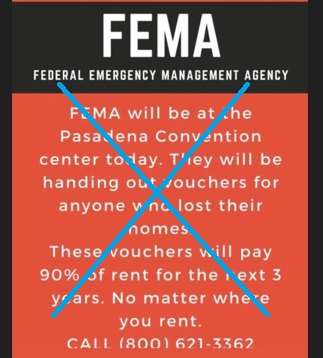
But that doesn’t mean there isn’t a rumor mill, and it’s a powerful one. Whispers spread almost instantly of buildings burning down that didn’t, FEMA giving out vouchers that it wasn’t, of families getting burned out that weren’t, lawyers skulking around with bad intentions, checks coming to you that aren’t, taxes or fees waived that weren’t, and on and on. The rumors are powerful, filling people with either false hope or unwarranted fear. And they are everywhere in my community right now, spread by people not out of malice but out of sheer desperation to know what the hell is happening and what happens next. Rumors are spreading because nobody knows anything.
“We don’t know” is a deeply uncomfortable answer. But for so many questions, it’s all we have.
When will the water be safe to drink again? We don’t know.
Is Altadena going to keep its charm and diversity? We don’t know.
Should I sign on to one of these lawsuits? Who’s fault even is this? We don’t know.
If it helps, there are ways I’ve learned to navigate rumors that spring from uncertain times. One very easy way, particularly when it comes to conspiracy theories (which aren’t exactly the same as rumors) is to simply not engage. Getting into an argument with idiots on Twitter about how fire works and that trees survive fires because they’re full of water is not a good use of anyone’s time. I’ve ignored most of the conspiracy theories just because they’re really stupid and a waste of the energy I have to expend on things like making sure I have clean pants (yes!) and am getting enough sleep (definitely not).
Rumors are harder to deal with because they come from a place that wants to do good, especially when it involves spreading around news of vouchers or checks or lawsuits or areas that are safe to enter. Be gentle with the people sharing them, because they’re trying to get answers and find help. We all are. Generally speaking, it’s a good idea to be extremely skeptical of anyone offering something that seems too good to be true, doesn’t make sense, or falls outside the bounds of how you know things work. If you see a meme or picture going around promising something or claiming something, that doesn’t mean it’s false, but it does mean you might want to take a few seconds and dig a little deeper – if you can. The rumors are flying so fast that it’s hard to even get a handle on all of them, much less see if any of them are actually true.
It also means not spreading news that hasn’t been confirmed, and that’s really hard to do. Even I’ve done it. I told our insurance adjuster that the Walsh house from Beverly Hills 90210 on Altadena Drive had burned down, when it hadn’t – “only” the house next door had. It’s a small thing and easily correctable, but I only said it because I heard someone else say it. Bad debunker, but understandable.
Most people in situations like this aren’t spreading rumors to be malicious or to troll people. Believe it or not, most people who aren’t terminally online and utterly brain poisoned don’t think that way. Rumors spread because we either want to know or think we know and want others to. It’s not a bad place to come from. Be gentle and understanding. We just want certainty and control, in a horrible time that offers nothing but uncertainty and helplessness.
When will I have a home to call my own like I used to? We don’t know.
Will my kids ever run around in our backyard, carefree and settled? We don’t know.
Is anything ever going to be the same again? We don’t know.
And it’s going to be a long time before we do. So the rumor mill will grind on, forcing us to cope with a deluge of falsehood and whisper, while we’re all just trying to get through the day and rebuild our lives.
Altadena will rebuild.


 Mike Rothschild