
This piece by music and culture writer Steven Hyden on music generally known as “Golden Oldies” got me thinking about forgotten tunes and about my mom.
Golden Oldies are very specific songs from a very specific era – rock, soul, pop, girl groups, R&B, and ballads from about the late 1950’s to the very early 1970’s, with an emphasis on 1962-1968. If it’s older than that, it probably falls under the rubric of “malt shop oldies” or “beautiful music” or something else you probably can’t find anywhere but satellite radio. And if it’s after 1969 – with a few exceptions – it’s “classic rock.”
Golden Oldies are not classic rock – but they can share the same artists and very rarely the same songs. In the case of the Beatles, “She Loves You” and “Help!” are Golden Oldies, while “A Day in the Life” and “Back in the USSR” are generally classic rock. The Stones’ “Satisfaction” and “Get Off of My Cloud?” Golden Oldies. “Miss You” and “Heartbreaker (Doo Doo Doo Doo Doo)?” Definitely classic rock. The Hollies featuring Graham Nash? Golden Oldies. Crosby Stills Nash and Young? Classic rock.
Like I said, it’s very specific. Some of these artists had one big hit and were never heard from again, others are still eking out careers playing on the county fair circuit. A few are still omnipresent in our culture: Elvis, Marvin Gaye, the Temptations, and the Beach Boys. But there are also mostly forgotten names with briefly popular hits like Jimmy Soul (“If You Wanna Be Happy“) and Len Barry (“1-2-3“) and British Invasion wannabees The Cyrkle (“Red Rubber Ball.”)
You’ll probably get at least some of The Who, CCR, Jefferson Airplane, and the Kinks. You definitely won’t get Pink Floyd, Led Zeppelin, or Genesis. Kids have probably heard of those bands. They’ve never heard of Golden Oldies, and probably think they’re stupid just because of the name.
Beyond any one artist or song, the biggest difference between Golden Oldies and classic rock is that every city of any considerable size in North America has at least one classic rock station that, in the last hour, has probably cranked out “Miss You,” “Back in the USSR,” or something involving someone in Crosby Stills Nash and Young as part of a Twofer Tuesday, a Commercial Free Rock Block, or Triple Play Thursday. Meanwhile, Golden Oldies have essentially vanished from the radio, with the format’s core songs and artists having disappeared from the memory of anyone under the age of about 45. Some iconic tracks – “Brown Eyed Girl,” “Good Vibrations,” “Bad Moon Risin'”, etc, migrated to what’s now classic rock where they get played alongside Alice in Chains and Poison. Everything else is just gone, while formats devoted to “classic hits” (ie, not rock but also not not rock) pump out a weird and incoherent mix of keystone artists like David Bowie and Elton John mixed with synth rock hits of the 80’s mixed with R&B of the 90’s mixed with pop hits of the last decade.
But that wasn’t what my mom listened to when she was driving us around the Chicago suburbs. She listened to Golden Oldies. Born in 1948, my mom would have been the prototypical fan of this music – a Baby Boomer. She would have grown up and had foundational times in her life infused by the burbling bass and anguished vocals of “Black is Black” by Los Bravos, the muscular horn lines of “Midnight Confessions” by the Grass Roots and “Vehicle” by the Ides of March, and the infectious exuberance of cuts like “Five O’clock World” by the Vogues and “Sweet Soul Music” by Arthur Conley. They weren’t even that old when I was first hearing them! Most had only been around for 20 years, give or take, in the 1980’s. Nevermind by Nirvana is older than that. Hell, Transatlanticism by Death Cab for Cutie, released in 2003, is older than most Golden Oldies were in the format’s heyday.
Because this was the music my mom listened to while driving us around, it was the music I listened to as well. I know all these songs almost by heart, despite not having listened to many in decades. Even the station ID bumpers for WJMK, the station she listened to the most, are seared in my brain, with the last few days being a constant loop of anonymous harmony singers chirping “Oldies 104.3….ChicAGGOOOO” before the chiming 12-string guitar of “Bus Stop” or the epochal “BOOM…BOOM BOOM BAM! BOOM…BOOM BOOM BAM!” of “Be My Baby” kick in.
When 1967’s “Sweet Soul Music” starts with its singer, who never had another hit, demanding to know “Do you like good music?!?” the answer was yes, because these songs are good.
They’re impeccably produced, with crisp vocals and harmonies knocking out hooks that instantly get stuck in your brain and never leave. They sound expensive, even if they weren’t, full of horns and strings and choirs. They’re warm and inviting and actually mixed with different instruments at different levels, as opposed to the relentless loudness of 90’s and 2000’s rock, or the shrill coldness of most of the top of the charts today. And they’re short, with most running around 2:30. All killer, no filler. Golden Oldies are great driving tunes, and even better party music, the kind of songs that when you put them on, someone invariably declares “whoa, I haven’t heard this in ages.”
So what happened to music from the 1960’s? Where did it go? Why does nobody who hasn’t gotten a colonoscopy remember any of this good music? It’s complicated and probably caused by a lot of factors.
My unscientific theory for why 60’s music vanished but not 70’s music is that most younger people heard Golden Oldies the way I did – on the radio in the car with their parents or at parties. When the generation of kids born in the late 60’s and into the 70’s started driving on their own, they looked for music that wasn’t corporate and played by the radio stations their parents listened to. They didn’t want that music, they wanted their music.
Radio stations compensated by dropping the 50’s and 60’s songs and adding more 70’s and 80’s songs – tunes that would have served the same function to Gen-X kids as Golden Oldies did to Boomers. “Black is Black” was out and “Back in Black” was in. Most finally succumbed to the younger demographic’s demand for songs that reminded them of their teenage years and got sold or changed formats. Chicago’s WJMK switched over to the now omnipresent faux “playing what we want” format of JACK-FM in 2007, flipped back to classic hits a few years later, and in 2017, became a classic hip-hop station.
Some of it was the format’s nature and the corporatizing of terrestrial radio. Most of these stations had extremely small and stagnant playlists, just a few hundred songs in some cases. After a while, people just got bored and moved on, or it was never meaningful to them in the first place. The classic rock stations that picked up a few Golden Oldies tracks had the same incredibly tight playlists, and a format that allowed for little deviation, and when new songs were added, they were newer songs – hitting the same nostalgia button as 60’s and early 70’s tunes did for Boomers and late 70’s and 80’s tunes did for Gen-X. They played what they thought people wanted to hear, and many people had heard it all so many times that they just shut the radio off, with satellite radio and streaming taking over.
Many hitmaking artists who never crossed over to classic rock essentially vanished when Golden Oldies faded away. Before bands like Styx, Cheap Trick, and (much later) the Smashing Pumpkins put Chicago on the map for rock, the Windy City’s own Buckinghams absolutely ruled 1967, scoring five Top 40 hits with bangers like “Don’t You Care” and “Kind of a Drag” before pop tastes changed, music went in a thousand different directions, and the Buckinghams were relegated to radio stations that now play Maroon 5 and Duran Duran or whatever.
Kind of a drag, indeed.
Of course, many of the people who made and sang and listened to Golden Oldies are gone too. My mom died at this time last year, six years after her once-beloved WJMK crossed into radio heaven. And sadly, she didn’t even become a classic hip-hop station, just a patch of ground and a headstone in a Jewish cemetery. That’s what happens when time marches on. Things and people you loved are gone, and you just have to keep moving forward. The old hits disappear and the new hits take over.
My mom left me with a love of classic songs that I now constantly inflict on my kids, put on to work or write, and listen to when I want to think about what it was like to be a kid in what I’m choosing to remember as a better and simpler time. They’re still great. They still soar and bounce and full of optimism and sunshine and horns and teenage anguish and fake British accents and goofy misspelled names like “The Cyrkle” and flute solos and singers yelling “HUH!” and “GOODGAWD!” the way you’re supposed to when you rock out.
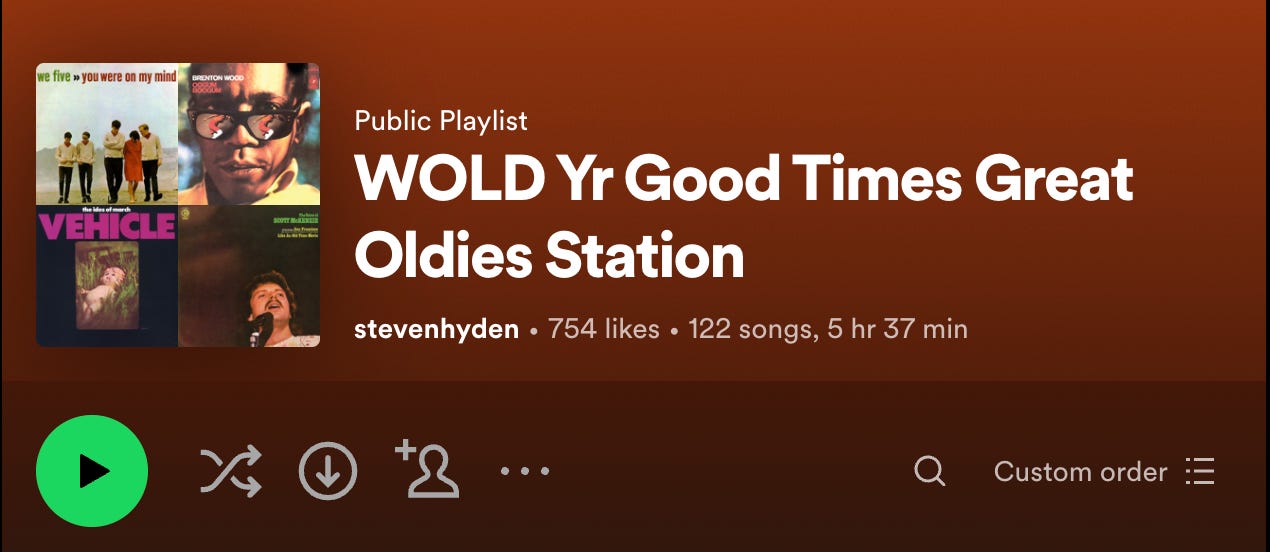
You have to put in some work to find these songs, but it’s worth it. Hyden’s piece has a link to a really good Spotify playlist that makes a strong starting point, and I linked to it below. YouTube has some compilations that aren’t quite right. You could also just click on some of the videos I posted and start going down rabbit holes. You might find a few clunkers, but you’ll also find some classic songs that maybe you heard once and have a vague memory of and will be delighted by all over again.
Whatever it is, it’s good music. And it deserves better than to be relegated to where the things and people we’ve forgotten go to when enough people can’t remember them.
This is the second piece I’ve written for my relaunched blog this week, and likely an example of something I’ll paywall in the near future. If you’re into more personal and eclectic stuff like this – or if you just like good music – consider subscribing on Patreon for just $8 a month. That will help me gauge whether people are into this stuff. Thanks!


 Mike Rothschild
You must be logged in to post a comment.