Why Did Music From the 1960’s Disappear?

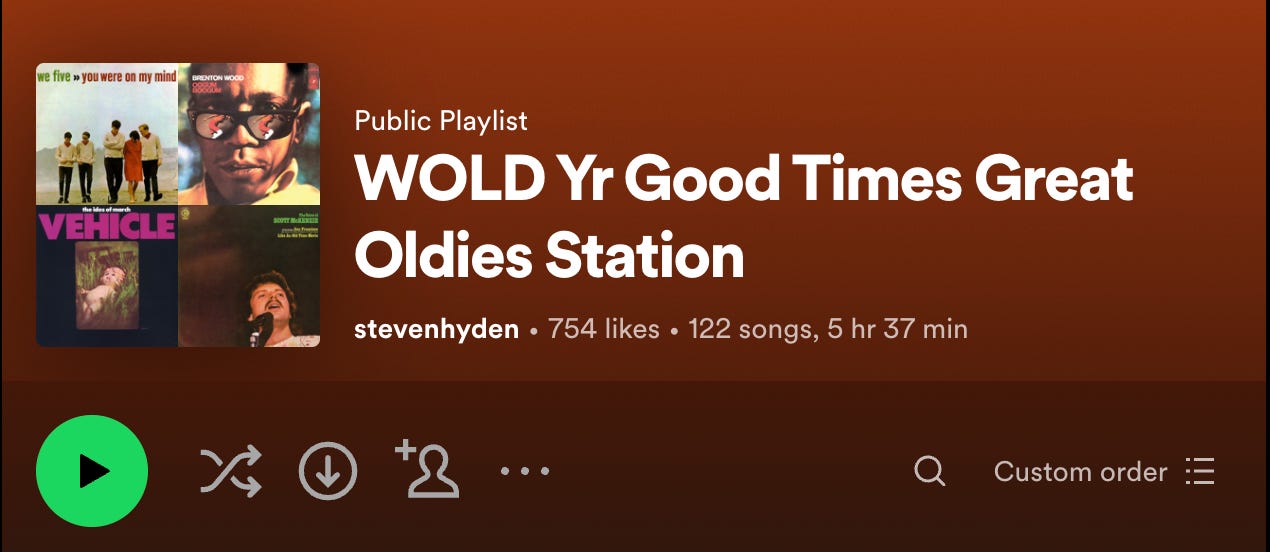
This piece by music and culture writer Steven Hyden on music generally known as “Golden Oldies” got me thinking about forgotten tunes and about my mom.

Golden Oldies are very specific songs from a very specific era – rock, soul, pop, girl groups, R&B, and ballads from about the late 1950’s to the very early 1970’s, with an emphasis on 1962-1968. If it’s older than that, it probably falls under the rubric of “malt shop oldies” or “beautiful music” or something else you probably can’t find anywhere but satellite radio. And if it’s after 1969 – with a few exceptions – it’s “classic rock.”

Golden Oldies are not classic rock – but they can share the same artists and very rarely the same songs. In the case of the Beatles, “She Loves You” and “Help!” are Golden Oldies, while “A Day in the Life” and “Back in the USSR” are generally classic rock. The Stones’ “Satisfaction” and “Get Off of My Cloud?” Golden Oldies. “Miss You” and “Heartbreaker (Doo Doo Doo Doo Doo)?” Definitely classic rock. The Hollies featuring Graham Nash? Golden Oldies. Crosby Stills Nash and Young? Classic rock.

Like I said, it’s very specific. Some of these artists had one big hit and were never heard from again, others are still eking out careers playing on the county fair circuit. A few are still omnipresent in our culture: Elvis, Marvin Gaye, the Temptations, and the Beach Boys. But there are also mostly forgotten names with briefly popular hits like Jimmy Soul (“If You Wanna Be Happy“) and Len Barry (“1-2-3“) and British Invasion wannabees The Cyrkle (“Red Rubber Ball.”)

You’ll probably get at least some of The Who, CCR, Jefferson Airplane, and the Kinks. You definitely won’t get Pink Floyd, Led Zeppelin, or Genesis. Kids have probably heard of those bands. They’ve never heard of Golden Oldies, and probably think they’re stupid just because of the name.

Beyond any one artist or song, the biggest difference between Golden Oldies and classic rock is that every city of any considerable size in North America has at least one classic rock station that, in the last hour, has probably cranked out “Miss You,” “Back in the USSR,” or something involving someone in Crosby Stills Nash and Young as part of a Twofer Tuesday, a Commercial Free Rock Block, or Triple Play Thursday. Meanwhile, Golden Oldies have essentially vanished from the radio, with the format’s core songs and artists having disappeared from the memory of anyone under the age of about 45. Some iconic tracks – “Brown Eyed Girl,” “Good Vibrations,” “Bad Moon Risin'”, etc, migrated to what’s now classic rock where they get played alongside Alice in Chains and Poison. Everything else is just gone, while formats devoted to “classic hits” (ie, not rock but also not not rock) pump out a weird and incoherent mix of keystone artists like David Bowie and Elton John mixed with synth rock hits of the 80’s mixed with R&B of the 90’s mixed with pop hits of the last decade.

But that wasn’t what my mom listened to when she was driving us around the Chicago suburbs. She listened to Golden Oldies. Born in 1948, my mom would have been the prototypical fan of this music – a Baby Boomer. She would have grown up and had foundational times in her life infused by the burbling bass and anguished vocals of “Black is Black” by Los Bravos, the muscular horn lines of “Midnight Confessions” by the Grass Roots and “Vehicle” by the Ides of March, and the infectious exuberance of cuts like “Five O’clock World” by the Vogues and “Sweet Soul Music” by Arthur Conley. They weren’t even that old when I was first hearing them! Most had only been around for 20 years, give or take, in the 1980’s. Nevermind by Nirvana is older than that. Hell, Transatlanticism by Death Cab for Cutie, released in 2003, is older than most Golden Oldies were in the format’s heyday.

Because this was the music my mom listened to while driving us around, it was the music I listened to as well. I know all these songs almost by heart, despite not having listened to many in decades. Even the station ID bumpers for WJMK, the station she listened to the most, are seared in my brain, with the last few days being a constant loop of anonymous harmony singers chirping “Oldies 104.3….ChicAGGOOOO” before the chiming 12-string guitar of “Bus Stop” or the epochal “BOOM…BOOM BOOM BAM! BOOM…BOOM BOOM BAM!” of “Be My Baby” kick in.

When 1967’s “Sweet Soul Music” starts with its singer, who never had another hit, demanding to know “Do you like good music?!?” the answer was yes, because these songs are good.

They’re impeccably produced, with crisp vocals and harmonies knocking out hooks that instantly get stuck in your brain and never leave. They sound expensive, even if they weren’t, full of horns and strings and choirs. They’re warm and inviting and actually mixed with different instruments at different levels, as opposed to the relentless loudness of 90’s and 2000’s rock, or the shrill coldness of most of the top of the charts today. And they’re short, with most running around 2:30. All killer, no filler. Golden Oldies are great driving tunes, and even better party music, the kind of songs that when you put them on, someone invariably declares “whoa, I haven’t heard this in ages.”

So what happened to music from the 1960’s? Where did it go? Why does nobody who hasn’t gotten a colonoscopy remember any of this good music? It’s complicated and probably caused by a lot of factors.

My unscientific theory for why 60’s music vanished but not 70’s music is that most younger people heard Golden Oldies the way I did – on the radio in the car with their parents or at parties. When the generation of kids born in the late 60’s and into the 70’s started driving on their own, they looked for music that wasn’t corporate and played by the radio stations their parents listened to. They didn’t want that music, they wanted their music.

Radio stations compensated by dropping the 50’s and 60’s songs and adding more 70’s and 80’s songs – tunes that would have served the same function to Gen-X kids as Golden Oldies did to Boomers. “Black is Black” was out and “Back in Black” was in. Most finally succumbed to the younger demographic’s demand for songs that reminded them of their teenage years and got sold or changed formats. Chicago’s WJMK switched over to the now omnipresent faux “playing what we want” format of JACK-FM in 2007, flipped back to classic hits a few years later, and in 2017, became a classic hip-hop station.

Some of it was the format’s nature and the corporatizing of terrestrial radio. Most of these stations had extremely small and stagnant playlists, just a few hundred songs in some cases. After a while, people just got bored and moved on, or it was never meaningful to them in the first place. The classic rock stations that picked up a few Golden Oldies tracks had the same incredibly tight playlists, and a format that allowed for little deviation, and when new songs were added, they were newer songs – hitting the same nostalgia button as 60’s and early 70’s tunes did for Boomers and late 70’s and 80’s tunes did for Gen-X. They played what they thought people wanted to hear, and many people had heard it all so many times that they just shut the radio off, with satellite radio and streaming taking over.

Many hitmaking artists who never crossed over to classic rock essentially vanished when Golden Oldies faded away. Before bands like Styx, Cheap Trick, and (much later) the Smashing Pumpkins put Chicago on the map for rock, the Windy City’s own Buckinghams absolutely ruled 1967, scoring five Top 40 hits with bangers like “Don’t You Care” and “Kind of a Drag” before pop tastes changed, music went in a thousand different directions, and the Buckinghams were relegated to radio stations that now play Maroon 5 and Duran Duran or whatever.

Kind of a drag, indeed.

Of course, many of the people who made and sang and listened to Golden Oldies are gone too. My mom died at this time last year, six years after her once-beloved WJMK crossed into radio heaven. And sadly, she didn’t even become a classic hip-hop station, just a patch of ground and a headstone in a Jewish cemetery. That’s what happens when time marches on. Things and people you loved are gone, and you just have to keep moving forward. The old hits disappear and the new hits take over.

My mom left me with a love of classic songs that I now constantly inflict on my kids, put on to work or write, and listen to when I want to think about what it was like to be a kid in what I’m choosing to remember as a better and simpler time. They’re still great. They still soar and bounce and full of optimism and sunshine and horns and teenage anguish and fake British accents and goofy misspelled names like “The Cyrkle” and flute solos and singers yelling “HUH!” and “GOODGAWD!” the way you’re supposed to when you rock out.

You have to put in some work to find these songs, but it’s worth it. Hyden’s piece has a link to a really good Spotify playlist that makes a strong starting point, and I linked to it below. YouTube has some compilations that aren’t quite right. You could also just click on some of the videos I posted and start going down rabbit holes. You might find a few clunkers, but you’ll also find some classic songs that maybe you heard once and have a vague memory of and will be delighted by all over again.

Whatever it is, it’s good music. And it deserves better than to be relegated to where the things and people we’ve forgotten go to when enough people can’t remember them.
This is the second piece I’ve written for my relaunched blog this week, and likely an example of something I’ll paywall in the near future. If you’re into more personal and eclectic stuff like this – or if you just like good music – consider subscribing on Patreon for just $8 a month. That will help me gauge whether people are into this stuff. Thanks!
We’re Talking About Joe Biden Completely Wrong

One of the hardest things about being of a certain age is that the people you once depended on start to depend more and more on you. They need more from you – more time, more energy, more help doing things they used to do without help, sometimes even more money.

Sometimes, having an elderly person who depends on you means making decisions. It means painful conversations and losses of things that they never thought they’d lose. Have you ever needed to take driving privileges away from an older person? Have you ever told them they have to move into assisted living, or it’s impossible for them to live independently without help?

Was it easy? Did they just hand over the car keys? Did they just shrug and say “I’ll start packing?”

They probably didn’t. They probably fought you, told you you were wrong, you were crazy, that they’re fine, that maybe they’ve slowed down a little and have a little trouble doing things, but that’s just part of getting old. They’re fine. And they don’t want to hear it again.

But you have to bring it up again, because they’re not fine. And before they drive into a tree or burn the house down or hurt someone, you’re going to have to resolve this. And on and on it goes, you push them to give up something, they push back that they don’t need to, and you argue and put your head in your hands and want to give up. You want to say “fine, let them drive off a cliff.” I tried. I give up.

But you don’t give up, because if you love someone and you see something about themselves that they don’t, you have a duty to keep telling them it’s there until they believe you.

Now take all of that stubbornness and denial and refusal to accept what the people around you have long ago accepted – and make it about the most important job in the world, a job that a lot of other people think only you can do, and that you believe if you don’t do it, we descend into a fascist hellscape.

That’s the problem with Joe Biden running for president again. It’s not that we’re asking him to give up the car keys or the house he lived in for fifty years. We’re asking him to give up being the most powerful human on the planet. And he doesn’t want to.

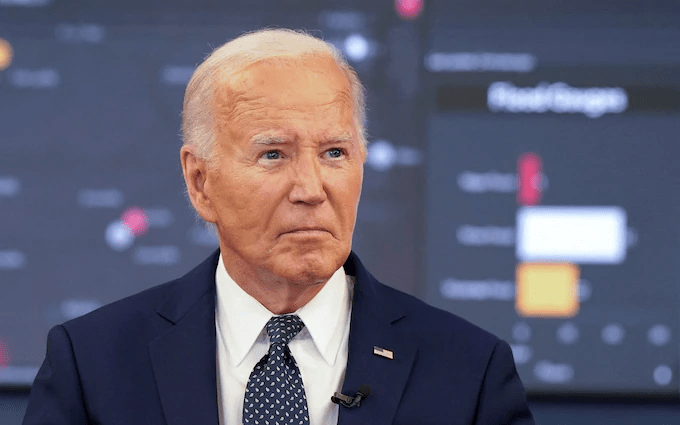
We’re talking about Joe Biden the wrong way. We’re talking about him like a political candidate, and not like a person. A person who is aging in a very public and ugly way. He is 81 years old, and will be 86 at the end of a second term. And nobody knows what that means for him, for his presidency, and for the country. But it’s hard to see it as anything positive or comforting. Not anymore.

Aging isn’t linear. It’s a slow decline in your faculties and abilities and memory and judgement and temperament. For a while, Biden could walk that line. It appears now that, at a minimum, he’s having trouble walking it. And his halting, quiet, feeble, mush-mouthed, incoherent, extremely painful performance in the June presidential debate against Donald Trump (who, it should be noted, is also mush-mouthed and incoherent, just much louder) proved it.

Biden’s defenders believe that him stepping aside and handing the nomination over to someone else, be it Vice President Harris or another Democrat, will be a disaster. They might be right, of course. They might also not be. They believe that Biden just had a bad night, that he was jet-lagged and feeling sick, that he was over-prepared and restricted by said preparation and let lag and sickness from “letting it rip.”

And again, they might be right.

But if you’ve watched someone you love age, you know that the Biden we saw during the debate is probably closer to the real Biden than anyone wants to believe. Yes, older people can have better days than their worse days. But Biden is only going to get older. Whatever is going on with him might ebb and flow, but it won’t get better. Aging doesn’t go in reverse.

It might happen again. Maybe even worse. And it might happen again when it’s too late to make a change without it seeming like chaos and a total lack of planning.

The conversation about Joe Biden stepping aside is one we should have had years ago. It’s one that should have been had based on reality, on the cruelty of aging, on the idea that one man does not define a political party, and on the knowledge that once you reach a certain age, things start to go wrong in ways that can’t be fixed and so maybe we should act before those things go wrong. It’s not ableist or ageist to see an extremely old man who is clearly breaking down in the way that almost all extremely old people do and point it out. To take the car keys away before he hits someone.

We are being told by Biden loyalists, social media influencers, and die-hards that all of this is just bedwetting and a waste of resources and does nothing but help Trump by ignoring his many flaws and horrors in favor of a media frenzy being goosed by the right wing oligarchs and rat-fuckers that run everything. That Biden is fine, he had a bad night, his appearances since then have gone better, and that we need to suit up, shut up, and get in line.

I reject all of this.

I reject the idea that the movement to push Biden to step aside is just more of the “but her emails” nonsense that sunk the Clinton campaign in 2016. Hillary Clinton’s emails were a minor story that was relentlessly exploited by the right wind media machine who had spent decades trying to destroy her. And the idea that the far right was actually concerned about information security is laughable given their unblinking acceptance of Trump keeping untold classified documents in the bathroom of his golf resort.

I reject the idea that criticism of the Democratic Party and of Joe Biden’s stubbornness is tacit support for Trump. It’s the exact opposite, it’s wanting the Democrats to put forth the candidate who has the best chance to win, and being extremely concerned that this might not be Biden, and even if it is, we should probably talk about it while we can.

I reject that anyone who is having serious doubts about Biden’s ability to win again, his age, and his state of mind are “bedwetters” who are panicking over nothing. The debate we’re having now is the debate that should have been had last year. It’s the sign of a healthy party that puts the good of the country over the ego of one man. We have one party like that already – the Republicans. Just because they will support their man no matter what he does, says, or inflicts on anyone else doesn’t mean we should do the same.

I reject the idea that Democrats wouldn’t support another candidate if Biden were to step aside. Sure, there would be crabbing and bellyaching over Biden leaving the field, but it’s ludicrous to believe that Biden diehards would stay home rather than support another candidate who was already lock-step in beliefs with Biden. Democrats did support a potential Biden replacement already: Kamala Harris, who 81 million people voted to step in for Biden should something happen. Well, something happened.

And I reject the ludicrous conspiracy theories that Biden was sabotaged by a rogue soundman at CNN, the excuses that he was in Italy 12 days before and was too tired to debate, and the self-serving demands to “unite or die.” If Biden thinks that the scrutiny he’s getting from his own party is bad, wait until Trump – who has been uncharacteristically silent the last two weeks – starts on him.

At the moment, the far right has been content to let the two Biden factions battle each other. But that won’t last much longer, and Biden is going to have to defend not only his record and presidency from the right, but his sanity and health and basic ability to make decisions. And it won’t be for the good of the country, it will be for the good of Trump – a man who puts nothing above himself.

Joe Biden is not like that. He is a man who puts country over self. Not many people are like that. But everyone gets older. Everyone loses the ability to do things they used to be able to do.

And everyone has loved ones that at some point will have to step in and make the decisions they might not be able to make anymore.

Because Joe Biden the person has reached the point where while it might not get worse for a while, it won’t get better. It never does.


This is the first post in what will be a relaunched TheMikeRothschild.com. For quite a while I’ve put it to the side while I work on bigger projects, but I’m missing the immediacy of regular writing. I hope to post twice a week, with one post more expressly political and/or fringe, and one a little more of a mix of things I care about and want to share. I hope you’ll share, subscribe, and do all the other things we ask readers to do these days. One post will be Monday or Tuesday, the other Wednesday or Thursday. I’ll develop more of a regular schedule as I go.

As part of relaunching the website and making it a viable way to use my time and resources, I’ve joined Patreon and will be asking readers to kick in $8 a month. Basically, a dollar a piece every month.

I know, everything is expensive and everyone wants your money. I get it. And I’ll keep everything free for now. But I truly hope that if you’ve ever gotten anything of value from something I’ve written, tweeted, or talked about in an interview, that you’ll chip in. And if you can’t, don’t worry about it in the least. Like I said, everything will be free until further notice.

Thanks for reading this far, and for everything!

(photo credit: Elizabeth Frantz/REUTERS)

The American Roots of QAnon, Part Two

The following is the second half of the speech I gave at Purdue University in early April on the uniquely American properties of the QAnon conspiracy theory. Because it wasn’t recorded, I decided to post it online, broken up into two parts because it’s really long. Part one can be found here. My books The Storm is Upon Us and the forthcoming Jewish Space Lasers are also available. Enjoy!

Another one of Q’s foundational theories had been floating around since the early 90’s – and it wasn’t the Clinton Body Count. It was the three-decade old prophesy scam built around a great financial awakening, known as NESARA.

First emerging out of the wreckage of another scam called Omega Trust, NESARA was like a lot other conspiracy theories in that it had its roots in something real, only to become completely engulfed in fraud and false hope. In this case, it was an economic proposal called the “National Economic Security and Recovery Act,” proposed by an amateur economist as a massive overhaul to the US financial system that would do away with the Federal Reserve, loan interest, consumer debt, and the current income tax. Its originator printed a thousand copies of his proposal and sent them to Congress, where he assumed it would be put to a vote at once. It was not, and it eventually found its way online.

That’s where it caught the eye of a victim of the Omega Trust scam, Yelm, Washington resident Shaini Goodwin. She saw it as a way to merge some of the conspiracy she’d fallen for with the more New Age-y aspects of NESARA, and went to work building a cult around herself.

Read More »

The American Roots of QAnon, Part One

The following text is the first half of the speech I gave at Purdue University in early April on the uniquely American properties of the QAnon conspiracy theory. Because it wasn’t recorded, I decided to post it online, broken up into two parts because it’s really long. Part two will follow later this week. Enjoy!

My name is Mike Rothschild, and I’m an author and journalist focused on the history and spread of conspiracy theories. And since you’re probably wondering, yes I debunk conspiracy theories while also sharing the last name of one of the most prolific subjects OF conspiracy theories of the last century, the Rothschild family. And no, I’m not related to the Rothschild family.

BUT the conspiracy theories about the Rothschild family are the subject of my next book, called Jewish Space Lasers and out in September. And in writing that book, I realized that for as universal as Rothschilds conspiracy theories are – they’re not called “globalists” for nothing – there’s also a deeply American aspect to them. The Rothschilds actually had very little success in the US compared to the rest of the world, but the conspiracy theories and myths about them are intertwined in American institutions, American paranoia, and America’s economic calamities. Even if the Rothschilds had nothing to do with them.  

Of course, Rothschild conspiracy theories are just one part of the buffet of madness that is QAnon. And while Rothschild theories started in Europe and migrated across the Atlantic, QAnon’s foundations are almost entirely American. Yes, it’s based on universal tropes – the blood libel, the Protocols of the Elders of Zion, and so on. And it’s become popular around the world, particularly with far-right movements in Europe and Australia. But Q has become popular overseas by sanding off its most American aspects, and exploiting universal unease over power, wealth inequality, and science.  

There is something deeply and uniquely American about QAnon. It’s built on layer after layer of past American conspiracy theories and hoaxes. It exploits deeply American evangelical fears and hopes. And it revolves around not just American politics, but the most uniquely American president – the outsider who claimed he would stick it to the elite and fight for the ordinary, forgotten American.

Read More »

QAnon is Dead, Long Live QAnon: Thoughts on the Q Twitter Ban

Late on July 21st, news broke that Twitter was finally taking action against accounts linked to the QAnon conspiracy theory, rolling out a multi-pronged approach to stop harassment and Q-related hashtags from trending. They’re also planning to ban QAnon accounts that engage in targeted attacks on other accounts, gaming hashtags, or trying to evade bans.

Despite having written extensively about Q over the last two years, I would like nothing more than this toxic prophecy cult to disappear for good and release the hold it has on its believers. In that respect, what Twitter has done here is a good thing: it will reduce Q’s visibility, make it harder for disinformation and conspiracy theories to go viral, and hopefully reduce harassment against celebrities and journalists who run afoul of Q.

https://twitter.com/MajorPatriot/status/1285742727553060866?s=20

But is it the end of Q for good? Will whoever has been making the mysterious posts on 8chan over the last two-plus years give up the ghost and reveal themselves? Will people walk away from the movement – or dig themselves in even deeper?

Here are some thoughts I have as a long-time conspiracy theory watcher:

Read More »