Eaton Fire #3: The Rumor Mill and What to Do About It

I’m an independent journalist and author with an uncertain road ahead and almost no time or space to do the work of debunking disinformation. To support my writing, please subscribe to my Patreon page, or Venmo me directly, @rothschildmd.


One of the reasons certain people are drawn to conspiracy theories and alternative realities is that they provide easy answers to complex problems. It’s comforting to believe that someone has a plan, has control over what happens to you, and can be blamed when it all goes wrong. Whereas the most difficult and frustrating answer to any question is the one that no conspiracy theory provides: the answer of “we don’t know.”

Losing your house in a vast cataclysm is a catastrophe that’s always going to provide more questions than answers, more rumors than facts, and more uncertainty than settled knowledge. As such, it’s rife with the possibility for exploitation, scams, fraud, and tumbling down rabbit holes of disinformation and conspiracy theory.

Some of the questions are philosophical and unanswerable. Other questions are scientific, about the random and unknowable nature of fire. Of course, there are the questions brought up by the conspiracy theorists and disinformation gurus. Those are the ones that I and my fellow journalists work hard to try to come up with the actual answers for, as opposed to the false yet comforting ones that so many believers get sucked into.

The vast majority of the questions, however, are logistical. They revolve around timing and contacting people and timelines and knowledge that you don’t have access to because nobody does. They involve things that haven’t been decided upon yet, or take varying amounts of time, or that there’s no plan for. Those are the questions for which “we don’t know” isn’t just the best answer, it’s the only answer, at least for now.

Will our neighborhoods be sold off to developers? We don’t know.

Where will the kids be going to school? When will they start? We don’t know.

What exactly is FEMA going to do for our community? We don’t know.

Since the fire, I haven’t been paying as much attention to the conspiracy theories – which is probably not something that a journalist who covers conspiracy theories should admit. For one, I’m too busy trying to rebuild our life. But beyond that, it’s too abstract, too unmoored from reality to seem to matter in the moment. And in many cases, they’re just wrong in ways that I know to be wrong. The conspiracy theory that “DEI firefighters” caused the blaze to grow out of control is ridiculous, because I’ve seen firsthand how courageous and skilled the firefighters have been. I don’t need to debunk it because the fact that virtually anything in Altadena still stands debunks it.

Conspiracy theories about “space lasers” starting the blaze, the fire being set by the deep state to cover up P. Diddy’s crimes, or Gavin Newsom using the fires as a giant land grab to create “15 minute cities” to take away our freedom haven’t come up at all in any of the chats, text threads, Facebook groups, or phone calls I’m in with fellow survivors of the Altadena diaspora. It’s just not something any of us give a damn about.

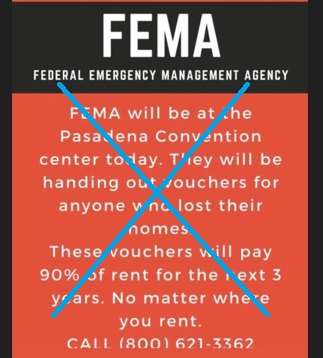
But that doesn’t mean there isn’t a rumor mill, and it’s a powerful one. Whispers spread almost instantly of buildings burning down that didn’t, FEMA giving out vouchers that it wasn’t, of families getting burned out that weren’t, lawyers skulking around with bad intentions, checks coming to you that aren’t, taxes or fees waived that weren’t, and on and on. The rumors are powerful, filling people with either false hope or unwarranted fear. And they are everywhere in my community right now, spread by people not out of malice but out of sheer desperation to know what the hell is happening and what happens next. Rumors are spreading because nobody knows anything.

“We don’t know” is a deeply uncomfortable answer. But for so many questions, it’s all we have.

When will the water be safe to drink again? We don’t know.

Is Altadena going to keep its charm and diversity? We don’t know.

Should I sign on to one of these lawsuits? Who’s fault even is this? We don’t know.

If it helps, there are ways I’ve learned to navigate rumors that spring from uncertain times. One very easy way, particularly when it comes to conspiracy theories (which aren’t exactly the same as rumors) is to simply not engage. Getting into an argument with idiots on Twitter about how fire works and that trees survive fires because they’re full of water is not a good use of anyone’s time. I’ve ignored most of the conspiracy theories just because they’re really stupid and a waste of the energy I have to expend on things like making sure I have clean pants (yes!) and am getting enough sleep (definitely not).

Rumors are harder to deal with because they come from a place that wants to do good, especially when it involves spreading around news of vouchers or checks or lawsuits or areas that are safe to enter. Be gentle with the people sharing them, because they’re trying to get answers and find help. We all are. Generally speaking, it’s a good idea to be extremely skeptical of anyone offering something that seems too good to be true, doesn’t make sense, or falls outside the bounds of how you know things work. If you see a meme or picture going around promising something or claiming something, that doesn’t mean it’s false, but it does mean you might want to take a few seconds and dig a little deeper – if you can. The rumors are flying so fast that it’s hard to even get a handle on all of them, much less see if any of them are actually true.

It also means not spreading news that hasn’t been confirmed, and that’s really hard to do. Even I’ve done it. I told our insurance adjuster that the Walsh house from Beverly Hills 90210 on Altadena Drive had burned down, when it hadn’t – “only” the house next door had. It’s a small thing and easily correctable, but I only said it because I heard someone else say it. Bad debunker, but understandable.

Most people in situations like this aren’t spreading rumors to be malicious or to troll people. Believe it or not, most people who aren’t terminally online and utterly brain poisoned don’t think that way. Rumors spread because we either want to know or think we know and want others to. It’s not a bad place to come from. Be gentle and understanding. We just want certainty and control, in a horrible time that offers nothing but uncertainty and helplessness.

When will I have a home to call my own like I used to? We don’t know.

Will my kids ever run around in our backyard, carefree and settled? We don’t know.

Is anything ever going to be the same again? We don’t know.

And it’s going to be a long time before we do. So the rumor mill will grind on, forcing us to cope with a deluge of falsehood and whisper, while we’re all just trying to get through the day and rebuild our lives.

Altadena will rebuild.

Eaton Fire #2: Lists Listing Lists

I’m an independent journalist and author with an uncertain road ahead. To support my work, please subscribe to my Patreon page, or Venmo me directly, @rothschildmd. Only if you can afford it, of course.


When you think that you’ve lost everything
You find out you can always lose a little more
I’m just going down the road feeling bad
Tryin’ to get to heaven before they close the door

The first thing you do when you find out your house burned down is to start making lists of all the things you’ll need to do next.

Ok, no. That’s nonsense. The first thing you do is suppress the urge to find a hole to get sick in. Based on the stories I’m hearing from folks who also lost their houses in the Eaton Fire, some are more successful than others. Hey, no judgement.

So then, the second thing you do when you find out your house burned down, after the vomiting, is start making lists of all the things you’ll need to do next.

For those who lost their homes in the wildfire plague of California, lists will become the currency of the realm. Notepads and piles of receipts become more valuable than gold. You will make lists on your phone, in your head, on scraps of paper, and in disjoined texts to yourself at three in the morning.

There are things you have to do for the remains of your last house so you stop paying for things you won’t need for a long time. You have to cancel DirecTV, your Stitch Fix subscription, your Amazon subscribe and save. You don’t want to get charged for your air filters and Flonase getting delivered to a burned out husk, after all. You have to call your mortgage company and explain very patiently that no, you don’t have a check from your insurance company to repair the damage to your house because your house doesn’t exist anymore.

Speaking of insurance, you have to start that ball rolling – assuming you’re lucky enough to not have gotten kicked off your homeowners policy. You have to make calls, start files, download pictures, and save everything electronically. They’ll want you to document everything you spend while out of your house, while also documenting everything you had in your house when it burned down so it can be replaced, or at least some version of it can be bought again. Assuming it can. The lists are granular and demand an absurd level of detail so as to make sure you don’t squeeze a few extra pennies.

Salad plates, white, ceramic, x12. Hundred year old brass Shabbat candlesticks, x2. Pushpins, clear, container, x1. Never opened.

You make lists of where you’ve stayed while on the road. Lists of things you’ll need to get at Target to be able to have something resembling clean clothes and some food, assuming they have anything left. Lists of people to thank for their generosity and kindness. Lists of donations. Lists of people to contact who you may or may not get around to. To-do lists for the next day, most of which you won’t get to because you’re strung out and wrung out and bone tired. Lists of lists.

Eventually, we’ll get to lists of things to do for the next house. But that’s so far down the line it’s not even possible to conceptualize it. So we stay in the realm of the immediate, the thing that has to get done today. That’s all any of us can handle.

Of course, there are other lists. I’ve seen multiple lists of businesses burned out of Pasadena and Altadena. Restaurants and shops and bars and people’s life’s work that are gone and might not ever come back. The coffee place where we grabbed horchata con espresso right after the elementary school holiday show. The dry cleaners where I took the suit I had made for my mom’s funeral – a suit that’s now gone. The bar in walking distance where I celebrated my 40th birthday, and where the bartender had seen me on CNN once.

And that’s to say nothing of the businesses burned out from the other fires, which I can’t even wrap my mind around yet. There are the lists of your friends who lost their homes, though in truth it would take less time to list those who hadn’t. There are the lists of the things they lost and the things they took with them. Some are heartwarming – the friends who were out of town but managed to get in touch with a neighbor who saved their cats and Social Security cards before the flames crept in. Others are ludicrous – the good friends who managed to save their house, while packing, among other things, a strapless bra meant for an evening gown. Hey, one day, right?

The lists come at you from every direction. Lists of historic structures, built from materials that aren’t made anymore. A century of American architecture decimated and just waiting to be turned into a vast field of glass and concrete shit boxes. Lists of places you can pick up free food and water, because the water in Altadena has been declared “do not use.” And there are the lists of GoFundMe pages from your friends, your neighbors, your community. You want to give to them all. But you can’t, because you need as much as you can get for yourself at the moment. A bottomless pit of need and despair.

The lists become documentation, not just for insurance purposes, but for remembrance. I’m finding in these first few days that witnessing and remembering is just as important as FEMA applications and itemizing Target receipts. Connecting with friends and going over what they saved, what they need, where they’ve been. Their lists. The list of our collective loss. This is how we even start to come to grips with what’s happened. We do it through writing it down, taking pictures, shooting videos, and leaving as many concrete reminders as we can.

So we make lists. We take notes. We scribble nonsense and send ourselves incomprehensible texts. It’s how we get through these days and do the things we need to do, but it’s also how we pay tribute to what we had and what we lost. Because there is just so goddamn much of it.

This piece will go up Monday, 1/13. We have a list of things to do for the day. Maybe we’ll even get to some of them.

Altadena Will Rebuild.

Eaton Fire #1: The Valiant Smoke Detector

The air is getting hotter
There’s a rumbling in the skies
I’ve been wading through the high muddy water.
With the heat rising in my eyes

What do you take when you’re trying to pack your house into your car and have no idea if you’ll be back again? Passports and tax files and the signed photo frame from your wedding, yes. The six bags of avocadoes you picked from the giant tree branch that was torn off int the windstorm earlier that day? Ah, no. The foul ball you caught at the Dodger game? The new LL Bean sweatshirt that you literally just got for Christmas and really liked? The artwork your kids made when they were 4 that were you probably were going to take a picture of and recycle? Hopefully – but probably not.

I saw the glow of the Eaton fire from my porch at 6:30 PM on Tuesday. It was distant, eerie, but not threatening. We had power. The wind was brutal, but our house was 100 years old and sturdy. A few hours later, we decided to be cautious and pack some things. We didn’t think too hard about it, because we weren’t even under an evacuation watch. We were being alarmist.

At 3:25 AM, our phones told us otherwise. We had to go. Now.

Of course, we had no power at that point and the house was freezing. The kids were freaking out. We were freaking out. I got dressed, but spent an inordinate amount of time looking for the right t-shirt, as if I were heading out for a night at the bar. We grabbed flashlights, filled water bottles, and grabbed a few more things. We left far more behind. We headed out into the howling wind, our streetlights dead to the world, and smoke filling our lungs like a bad day on the Western Front. We drove south, my radio still tuned to the SoCal Sound, a relic of another life a few hours ago.

Twelve hours and another evacuation later, we knew house was gone. We had an inkling – a neighbor sent us a screengrab of a KTLA report of their house on fire, with ours in the distance, also burning. Maybe it was just the avocado tree, right? Firefighters were there, so we may have gotten lucky. Around the same time, our smoke detector started sending us alerts, valiantly doing its job to the last, as it probably melted. We told ourselves that the air was a horror show, and just because the alarm was going off didn’t mean our house was necessarily on fire.

It was. Now it’s gone We haven’t seen what’s left of it yet, but neighbors and friends who have snuck back into the area told us, and a few took pictures. We recognized the porch, the coral tree in the front yard, the pavers. Whatever’s left won’t be useful, likely. Today, we started the process of filing an insurance claim, putting our mortgage on pause, and, oddly, cancelling the coffee subscription that sustained us on seemingly endless mornings getting our kids out the door.

We’re safe and far from the fires now. The air is cool and slightly acrid, but nothing close to Altadena, which is still something of a war zone. We’re heading north tomorrow, reduced to refugees in a parade of plug-in hybrids. You always think of people fleeing catastrophe as slow-moving lines of families pushing carts with their meagre belongings, and women wearing babushkas, heading west to avoid rampaging hordes. That’s us now. Except our babushkas burned alongside our avocados, the foul ball from the Dodger game, and the LL Bean sweater.

We aren’t alone in our journey. So many families and friends lost homes that it would be easier to list those who didn’t. Altadena is a tight-knit and quirky community where people come because they want to escape the packed-in constant closeness of LA. It’s affordable, or at least it used to be. Because of the Pasadena area’s long history of segregation, Altadena is where many Black families were able to buy property, and the city is a working-class mix of races and cultures and incomes, all living together in 100 year old cottages and Craftsman bungalows.

Over the last decade, what was once a bit of a wilderness had become a place where younger people and working class families wanted to move, because of the vibe and the green open spaces and the quirky feeling of a place that wasn’t urban, wasn’t suburban, and wasn’t rural. You were five minutes from hiking trails that took you to a waterfall, and a half hour from Dodger Stadium. Nothing like this existed anymore in LA. This wasn’t influencer country or glass and steel box McMansion hell. Celebrities moved into town and nobody knew who they were. Little league teams overran pizza places after games, and the local park drew huge crowds on Sundays for organized soccer games where nobody spoke English. People in Altadena look out for each other, families let their kids walk around the block the way kids used to, we protect the look and historical nature of our houses, and you always run into someone you know when you go out for tacos. It’s a community. A village.

I have no idea if that’s gone for good, but it’s gone for now. It vanished with the fire that I watched grow from a distant glow to a looming inferno to a destroyer of stability. And it’s still going, one of many fires turning Los Angeles into something unrecognizable, driven by a vicious wind that people who lived here for half a century said they’d never experienced. Victims of a planet that increasingly seems to not want anything to do with the fossil fuel and cheap plastic obsessed humans who control it.

Because it’s 2025, there’s been some negativity, conspiracist fearmongering, and brain-rotted lunacy. I’ll get to some of that eventually on this blog. But it’s been vastly outweighed by generosity, mutual aid, good wishes, offers of lodging and financial help, and people reaching out to give whatever they can. The spirit of everyone being in this together that we had in the early days of the last generational trauma we suffered through, the pandemic, is being felt even by people who are not actually in this. It’s incredibly heartening, and I’ll carry it with me right alongside the memories of the stuff we lost, the panicked run from our house, and the confusion and anguish of the next day. It’s bad, but it’s not all bad.

Thank you for going down this road with me as I attempt to document life as a climate change refugee. I can’t commit to any kind of regular schedule, pretense of editing, or coherence. I’ve had eight hours of sleep in two days, so I’m not sure if I’m actually typing words at this point. But I hope to write down what I’m going through, so I remember and so other people can experience something that nobody should ever have to experience. I want to chronicle our adventure, Altadena’s rebirth, and Los Angeles’ future.

And for god’s sake, make sure all your important documents are in the same place.

More to come.

To support my work during this difficult and uncertain time, please subscribe to my Patreon, or you can donate directly to my Venmo, @RothschildMD. Please only give if you can afford to.

Altadena Will Rebuild

January 6th and the Rewriting of Memory

Upon his soldiers discovering the first Nazi concentration camps in western Europe, Supreme Allied Commander Dwight Eisenhower personally toured the sites of the Final Solution. Writing in his memoirs after the war, Eisenhower said he “visited every nook and cranny of the camp because I felt it my duty to be in a position from then on to testify at first hand about these things in case there ever grew up at home the belief or assumption that `the stories of Nazi brutality were just propaganda.’” He would also ask members of the press and Congress to walk the grounds and see what he and his men had seen, so they could show it to the public “in a fashion that would leave no room for cynical doubt.”

As many journalists and observers will write about, today marks four years since the assault on the US Capitol by a mob of Trump supporters determined to overturn the results of the 2020 election – or die trying. And while Eisenhower insisted the camps be documented so that nobody could deny their existence with any credibility, cynical doubt and propaganda are now the currency of the west.

With a few exceptions, Holocaust denial never flourished beyond the fringes of neo-Nazi dead-enders and Hitler worshippers selling pamphlets to each other. But January 6th denial and the rewriting of current events, has shown enormous staying power and mainstream appeal, to the point of being one of the biggest factor’s in Donald Trump’s improbably comeback. The thing that looked to have doomed his political career is now its engine.

The rewriting of history around January 6th has become an industry that denial of the camps could never have become. If you deny that millions of Jews and other “undesirables” were murdered by a methodical Nazi machine, you’re probably not going far in mainstream public life. But if you deny that January 6th was an organized attempt to violently seize total power and nullify an election, you’re probably going to be a superstar in the GOP. You might even get your own podcast.

The American press covered January 6th, its planning, its minute-by-minute execution, and its prolonged aftermath with as much vigor and enthusiasm as maybe any subject since 9/11. But for a certain segment of the population, all of it was a lie. To Trump, his inner circle of acolytes, and his vast (and growing) base, January 6th wasn’t an insurrection, it was a “day of love” meant to show support for the rightful winner of the election. The angry, violent, armed, unhinged mob that breached the Capitol was actually a “sightseeing tour.” The instigators of the insurrection weren’t a loose alliance of racists and anti-government extremists, but actually federal agents directing these peaceful tourists who were just there to express legitimate political differences and their sincere belief that the 2020 election was stolen.

On and on the false history goes, rewritten on the fly by cynical grifters and political hacks. The Capitol Police were the unhinged ones who viciously attacked the meek and humble Trump supporters, while the peaceful patriots caught up in the dragnet are hostages and political prisoners. Nobody was there to hurt anyone except the fed plants and undercover antifa soldiers who turned the day dark. There were no Republican criminals that day, the real criminals are the Soros-funded Trump-hating members of Congress investigating the “attack” to influence the 2024 election. Democrats in Congress weren’t under siege that day, they planned the attack or, at the very least, allowed it to happen. And Donald Trump never told anyone to do anything wrong, and did nothing wrong himself. He even told the “mob” to go home peacefully and that he loved them. Because it was a day of love.

Falsifying history gets easier as events recede and witnesses die off. But falsifying current events takes willpower, commitment, and a vast and relentless drive to tell yourself that the things you saw happen didn’t happen. It doesn’t mean you’re being lied to, like a conspiracy theory requires. It means you’re lying to yourself. Over and over and over. And if we know one thing about devotion to Donald Trump, it’s that self-delusion is a requirement.

Reeling from his loss and his party turning against him in the days after January 6th, Donald Trump decided that the only way to recover from the event was to created an alternative history of it and act as if it were the real one. At first, he was in exile, rambling to a seemingly shrinking audience that he’d won the election, that January 6th was a setup, and that the people who rioted and killed for him were heroes.

The falsified history was that not only did Trump do nothing wrong, but nobody did anything wrong except the Democrats and law enforcement. And he just kept at it, relentlessly, and with no oxygen given to any other narrative.

Of course, it worked. It started working on the same day as the attack, with hundreds of thousands of tweets immediately calling the riot fake, a false flag, and a fed hit job – all based on Trump’s own casting of blame elsewhere. In the months after the insurrection, when ardent Trump acolytes in Congress began shifting blame to mythical FBI plants and antifa infiltrators, it was in full swing.

The Republican history of January 6th, the one clung to by the party that will soon control every branch of the federal government, is that it was a peaceful protest ruined by federal jackboots and outside agitators. And it’s a protest that the American people, much more concerned about the price of eggs and the possibility of being raped by Haitian migrants, don’t care about anymore. Soon it will be swept out of the history books entirely, with Trump pardoning all the “hostages” and going after the investigators who tried to hold him to account

It never happened.

Except, of course, it did happen.

Relatively few people saw the immediate aftermath of the Nazi camps, and virtually none are still with us. Most of us only know of the Nazi horror through the footage taken in the aftermath, the testimony of those who survived, and the blubbering fake repentance of those who did the deeds. But millions of Americans were watching the news and seeing in real time how the American electoral system teetered on the edge.

We all saw it together. Our hearts raced and our jaws dropped and we all asked ourselves and each other “can this really be happening?” Because it was happening. We heard the screams of the Capitol Police officers being torn apart. We saw the blood on the floors and the shit on the office walls. We know it wasn’t a peaceful love fest, but a sacking that would make a Visigoth proud. We know what January 6th was – not a “day of love”, but an organized and well-planned attempt to prevent a presidential election loser from transferring power to a presidential election winner. Even Trump’s most ardent supporters knew what it was. Until they decided otherwise and began lying to themselves.

The more an event is documented, the more effort needs to be put into making us question our memories of the event. And that’s ultimately what J6 denial is about – not even so much rewriting history, but rewriting our memories. Trying to convince us that what we saw wasn’t what we saw, what we experienced wasn’t what we experienced, and our feelings – our horror – weren’t real.

Don’t let Trump and his acolytes rewrite your memories of that awful day. Take them with you, speak of them often, tell those too young or disengaged to have been watching what you saw. Don’t allow them to cynically deny what they did, and never question the depravity and deeply unpatriotic derangement of those who did it.

It remains to be seen whether Trump will pardon those responsible for January 6th. But no matter what their legal outcomes are, we can hold them to account with our memories and witnessing. We must all be the documentarians of the horror of January 6th, and we can never allow ourselves to be convinced that it was anything else than what we saw.

To support my work, please visit my Patreon page. Thank you!

Droning On and On

In 2016, Americans suddenly and somewhat hilariously became terrified of killer clowns. The creepy mirthmakers were spotted in South Carolina luring children into the dark woods, in Green Bay handing out black balloons, skulking around cemeteries in Chicago, randomly knocking on doors, intimidating residents, and approaching young girls in the open. The creepy clowns made their way to the UK, where they intimidated and pulled pranks on people in car parks and streets. One even ran for president.

Four years later, with the world on lockdown, boredom and fear walked hand in hand. That summer, full of tension and dread, people started to notice that every night in big cities, huge numbers of fireworks were going off in the middle of the night. Nerves were rattled and people were frustrated – and scared. Immediately, panic set in that this was a military exercise designed to rob us of our sleep, police activity designed to spur arrests, or even a Trump-ordered test to immunize the population into becoming accustomed to the sound of explosions and artillery.

Cut to 2024, another presidential election year involving Donald Trump. And sure enough, there’s another panic spreading through the plugged-in population over social media: drones. Thousands of drones, all the size of large cars, flying in straight lines and coming out every night (and only at night), hovering over population centers and military bases, and scaring the crap out of us. Is it a false flag to prepare us for alien invasion? A military exercise that Trump will use an excuse for martial law? An attack on American from Iran or China? Proof that nuclear weapons are being trafficked by nefarious forces and the government is desperate to find them? It’s now the Drone Panic of 2024, and it’s spread from news of drones over New Jersey to drones over everywhere.

Taken together, it seems like these three panics prove one of two things: either every presidential election now comes with a deep state engineered panic meant to distract and exhaust us in the face of the oncoming horror, or that Americans are nuts.

Of course, neither of these are the sole explanation. Societal panics are nothing new, and take place all the time fueled by new technology and collective unease. And many Americans, like people of every nationality, are conspiratorial and fueled by fear of what they don’t understand.

In the face of calls for the government to “do something” or “be more transparent” or “shoot them down,” it’s important to realize that what people are pointing out as drones are not actually drones.

They’re airplanes coming in for a landing, stars, planets, satellites, helicopters, optical illusions, deepfakes, hoaxes, and maybe a few commercial drones. They’re the same specks of light that have been in our sky for generations. There might be more of them now, thanks to outfits like Starlink and the revitalizing of commercial aviation post-lockdown. But at any time since the advent of the passenger jet, if you look up at night, you’re going to see something bright and flickering moving across the sky, or maybe appearing to hover, or maybe not moving at all. Isn’t it strange how the “drones” never seem to appear during the day? Or how countless SUV-sized craft are flying around and none have crashed, hit each other, or just stopped working over a busy city? Don’t expect answers from those panicking.

So why did the Great Drone Panic of 2024 happen, and what can we learn from it?

Panics rarely start over things that never happened, they start over isolated incidents that are blown massively out of proportion

In the case of recent past panics, they started with something real that spread over social media because it was equal parts absurd and terrifying. Clowns occasionally go about town in their clown getup, and scare the hell out of people in the process. (Incidentally, if I get a few new Patreon subscribers, I’ll post my own story about being at an event in Los Angeles with a clown that was very much not an event for clowns. It’s wild.) The fireworks panic was the same thing, at first – the nightly fireworks bombardments were real, but there was never any evidence that “the government” or “the cops” were behind them, other than unverifyable social media posts. It turned out that fireworks companies were desperate to unload excess product that wasn’t going to be used for 4th of July shows because of lockdown. No conspiracy required, just one made up to fit the facts.

Drones have become omnipresent, especially in war, but few people know what they really look like

Even just the term “drone” has scary connotations, especially for anyone who watched the Great War on Terror unfold live on cable news every night. It conjures up sinister forces using cryptic orders to fire missiles at weddings, killing you before you even know you’re a target. But drones can be anything – from hobbyist quadcopters to commercial drones delivering packages to lights flying in formation to create a nightly show to military grade missile carriers. Some drones are tiny. Others, like the Shahed 136 drones hammering Ukraine on a nightly basis, are 11 feet long, nearly the length of a compact car. There are over a million of them registered with the FAA, and there’s no doubt that at least a few of the “drones” are actually drones. Because there are so many different types of drones, it’s easy to look at something in the sky and tell ourselves it must be a drone. We don’t have to know what type of drone, or who launched it. It’s a drone. And drones can kill us.

Panic spreads because when we go looking for things, we find them

If you go outside on a cold night with the intention of seeing a drone, you’re probably going to see a drone. Why? Because why would someone go outside to see something and not see it? We like to find the things we’re looking for, and to not be disappointed. We want to be able to tell our friends and social media followers that we saw a drone, not that we saw a plane or a star. Ultimately, “I saw something” is a more compelling – and potentially viral – story than “I didn’t see anything.” That’s boring.

It’s a weird time where not much is happening

Americans have been on a relentless run of breaking news for years, and maybe no year more than 2024. We had stretches where absolutely insane and game-changing things were happening every day, and with Trump’s election, that seems to have calmed down. Yes, his cabinet nominations and goofy lawsuits are news, but they don’t the heady high-wire thrill of assassination attempts or last minute candidate changes. People are a little bit bored at the moment, and when people get bored, conspiracy panics start. When we lack danger and thrill in our lives, we find ways to make them up.

A lack of basic understanding about physics makes us turn the ordinary into the extraordinary

If you’ve ever driven across Los Angeles at night going north from LAX, you’ve seen a line of what look like floating blobs of light just hanging in the air. And because you’re at one of the busiest airports on the planet, you know they’re planes coming in to land, and not UFOs or drones or whatever. But if you’ve never lived near a major airport or flown into a big city at night, you might not be familiar with why descending airplanes look like they’re floating. So when you see it for the first time, your mind assigns meaning and danger to it. For the record, there’s a name for why descending airplanes appear to be floating. It’s an optical illusion called the parallax effect, It’s a difference in how the brain perceives rates of motion when moving, which is why closeup objects look to be moving quickly, while faraway ones look to be moving slowly or stuck. Parallax is a critical depth perception tool, not a deep state conspiracy. It’s basic physics – but a lot less entertaining and alluring than the unevidenced alternatives.

The “I know what I saw” fallacy

So many of the claims of drone sightings ultimately fall into some version of “I saw three lights in the sky forming a triangle. Triangles in the sky are UFOs. Therefore, I saw a UFO. And I know what I saw.” We aren’t interested in other explanations, such as the three lights being the lights on the wings and nose of a plane. We know what we saw. Except most of the time we don’t know what we saw, only that we saw something, and decided we knew what it was. Our brains have a remarkable ability to create stories out of things that didn’t happen, or that we only saw a glimpse of and filled in the rest. Maybe the best example of this is the numerous witnesses to TWA Flight 800 exploding who claimed they saw and then immediately heard a missile hit the plane, despite the laws of physics making this impossible. The people who told the FBI this weren’t lying, they were just convinced they saw something that they could not have experienced. And the more you tell them they’re wrong, the more they believe they’re being called a liar.

We’re just really into conspiracy theories right now

This might be the simplest explanation of them all for why drone panic hit so hard and so fast. Americans, just like all humans, are innately prone to pattern-seeking and making meaning out of randomness. But 2024 has seen the continuation of conspiracism and paranoia creeping into our everyday lives in a way that was never even possible just a few decades ago. Our political leaders and cultural titans spread disinformation the way a knife spreads butter. Even Donald Trump has stoked the drone panic, claiming without any evidence that the government “knows what they are” and telling his followers to shoot them down. Other influencers have claimed, also without evidence, that the drones are part of a desperate attempt to find a nuclear warhead, or a Russian disinfo op, or a secret coup plot. This used to be the stuff of rambling drunks at bars and your weird uncle at Thanksgiving. But it’s everyone now, and it’s everywhere we look. And that now includes the sky at night, once a place of awe and wonder, but now cluttered up with planes and satellites and ever-present low light blotting out the glory of the stars.

So what can we do to abate drone panic? Like all pushback against conspiracy theories, think micro and not macro. Stop sharing random videos that “saw a drone” flying somewhere, because absent other evidence, it’s not a drone. If you go looking for drones, expect not to find them. If you see a blob of light floating in the air, think about airports near you, not motherships and aliens. Get familiar with the stars and planets at night in your area, so you know what they are and are not. They’re pretty cool to look at.

And disabuse yourself of the notion that you are a player in a secret nighttime war between good and evil, being played out through drone swarms and viral panic. Take the opportunity to become acquainted with something bigger than your own life – in this case, the very cosmos that made us. It’s a hell of a lot more breathtaking than panicking over nothing.