Eaton Fire #16: Six Months Out

The Eaton Fire was six months ago today, and we’re still in the early stages of rebuilding our home and replacing the decades’ worth of things we lost. If you can help at all, a subscription on Patreon would be greatly appreciated. I promise to post more exclusive content on there once I get a little more settled in a new work routine. Thank you!


Nobody can prepare you for when disaster personally strikes you. You can read up on disaster prep, you can stockpile canned goods and batteries, you can even write down your plans and practice what you’ll do and where you’ll go. But if it happens, a lot of that won’t matter. Certainly the canned goods, batteries, and cash we had did us little good as our house went up in flames. It became just more stuff to melt and clean up.

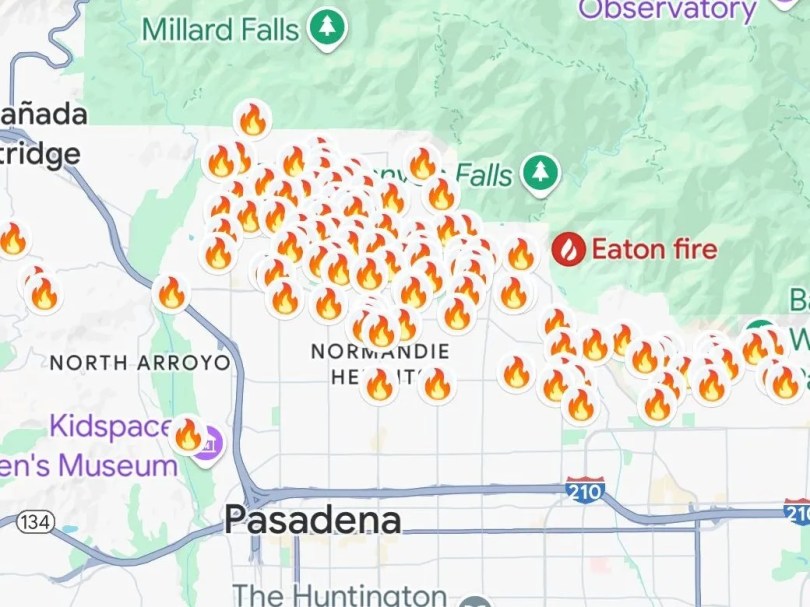
We are six months out from the Eaton Fire burning down our house, our possessions, our neighborhood, much of our town, and many of the businesses and places we went to.

How are we doing, you ask?

The short answer is…*shrug*

The longer answer is that it’s complicated. We’re doing fine. We’re doing terrible. We’re exhausted. We’re energized. We’re coming to terms with it. It’s all bunch of bullshit. It could be worse. It could DEFINITELY be better.

Certainly, it’s different now. We spent hours, then days, then weeks, driving a train with no track in front of it, and no destination other than somewhere else. Then we got somewhere else. We settled into a routine of phone calls, emails, lists, Zoom meetings, panicky freaking out, sleepless nights, remembering things we lost, and doing it all over again the next day. We went back to work, the kids went back to school, we started paying bills and making plans and trying to create some semblance of order in the somewhere else we’d landed in. We tried to make it, if not normal, then less chaotic.

It’s never going to be normal (whatever that is), but it’s not pants on fire crazy anymore.

And the rest of the world mostly moved on, as it should have and as it always does. For the hundreds of millions of Americans who didn’t lose their home in the January fires, there were more pressing concerns – work, school, political nonsense, TV, sports, going out to bars, doing whatever it is that people do and whatever it is we used to do. Eventually we even starting doing some of those things – we’ve gone to birthday parties and baseball games and I’ve even managed to watch some good TV.

But moving on? No, we’re not doing that. We are still trying to survive the fires.

Six months later the chaos and upheaval remain. Many of us are still performing the humiliating ritual of looking for a new place to live every few months. We have friends who are nearing double digits in the number of addresses they’ve lived at since January. We’re struggling to deal with insurance companies who want us to move back to unlivable homes, with landlords who have decided to abdicate any sense of responsibility or humanity, and with the vagaries and uncertainties of rebuilding. LA itself feels like it’s still in a haze of uncertainty, which isn’t being helped any by the current administration’s constant efforts to make things harder for us.

And we’re doing it with far less help than we had in the early days. The GoFundMe drives have long since ended, grants are mostly down to a trickle, and the Disaster Recovery Center that many of us spent more time in than our actual homes or workplaces is closed. Many of the agencies who staffed it are facing massive budget and personnel cuts – with an onslaught of summer weather disasters staring them down.

Meanwhile, building costs go up, ICE raids are thinning out the available pool of workers, and erratic tariffs mean it’s almost impossible to pin down how much new homes will cost – only that they will cost more than any of us were insured for. The long-term effect on our mental and physical health is just as unknown, as an entire city tries to cope and compartmentalize the trauma we’ve all gone through, just a few years removed from the trauma of COVID.

I still wake up remembering things we didn’t take when we evacuated. The grief of losing the house mingles with the grief of losing my mom, which has its own anniversary next week. I’ve lost things that were meaningful to me, books and t-shirts from college, cards from our wedding, LEGO pieces that were 40 years old and that aren’t made anymore. Some could be replaced at great expense, others never. And I still hear the shrieking siren of the emergency evacuation alert in my head. Not as much as I used to, but it’s there. I relive evacuation day all the time, I remember every aspect of it like it was yesterday, even as I struggle to remember to do basic things that have to get done, or what people’s names are. As it turns out, trauma and cognitive impairment go hand in hand. So that’s great.

But it’s not all doom and despair.

We’ve gotten closer to our community and our neighbors, as gatherings at parties and kiddo activities become impromptu group therapy and recovery sessions. Our kids have amazed us with their resilience and humor. Many of us, though certainly not all of us, are getting a chance to build brand new homes. I’m only half-joking when I say that the fire helped me with my clutter problem and stalling on upgrading my wardrobe. And I’ll never run out of things to talk about in therapy – or write about or be interviewed about.

But beyond all that, the last two years, from losing my mom in July 2023 to losing the house a year and a half later, have told me that I’m far stronger and more durable than I could have imagined. I have endured multiple life-altering losses, and I’m still here, still cranking away at my work, still deluging my kids with corny dad jokes, still rooting for the absolutely terrible White Sox, still trying to be a good husband and person and citizen. Trying to pay forward and pay back all the goodwill and generosity we’ve gotten in the last six months.

And still getting out of bed every day, doing what I can to help us rebuild. Six months is a long time, and not a long time at all. So if you feel like it, check in with me or another fire survivor. Or any trauma survivor anywhere, who is dealing with things a long time after they happened.

We would appreciate the love.

Eaton Fire #6: Desolation Row

I’m an independent journalist and author with an uncertain road ahead. To support my writing, please consider a paid subscription to my Patreon page, or you can Venmo me directly, @rothschildmd. Thank you so much!


I’m wiping my house off my shoes.

As I ran yet another sanitizing wipe over my New Balance 990’s – now the only pair of shoes I own – it struck me that I was removing particles of what used to be the house I thought I’d spend the rest of my life in.

We’d been told in no uncertain terms that the ash left by the fire was toxic. It was likely full of microscopic residue from melted plastic, exploded propane tanks, and whatever happens to electronics when they burn real good. While we haven’t started sifting through the rubble, we did take our first direct look at what used to be our house, after driving through some of the other parts of Altadena where houses and businesses used to be. And it was a punch in the gut, just as we knew it would be, and just as it’s been for thousands of families burned out by the LA fires.

To pick up where we left off, we got back to Pasadena from the Central Coast on Wednesday night. Right away, Pasadena seemed different. It was quiet, still, and reeked of a fireplace that’s been left smoldering too long. The fires are almost entirely contained, but the air smells of soot, stale smoke, and char. It feels gritty – if air can, indeed, feel gritty. And there are firefighters and utility workers and tree surgeons and county officials everywhere. Just in the few minutes it took to go from the freeway exit to where we’re staying, one truck zoomed by with its lights and sirens blaring, and we saw at least two others. Sirens seemed to be constant.

It was better in the morning, at least in terms of air quality. Not in terms of exhaustion, dislocation, anger, and malaise. That’s not better. Morning doesn’t work miracles. Finally, after a day spent in the customary fashion of trying to get a dozen things done at once and accomplishing maybe three, we decided to head out to see the house. We’d tried twice before we evacuated, but couldn’t get close. The fires were still burning. The air was at its grittiest. But that was two weeks ago. It wasn’t time then. It was now.

I’ve never been in a war zone, but I’ve seen a lot of them on TV. Altadena might not look like an actual war zone, but it certainly looks like one on TV. It has the distinct patina of newsreel footage of Dresden after its February 1945 firebombing, or a BBC remote from Baghdad after an IED went off in front of a market. Massive stores, gutted and hollowed out. Homes reduced to crumbled plaster and charred wood. And just for good measure, armed soldiers in the streets in the form of National Guard members, assault rifles at the ready, there to prevent looting. The city looks like it’s been the subject of a strategic bombing raid, with some homes and shops untouched, and others destroyed.

We drove past the homes of our neighbors and friends, now just empty shells with melted cars in front. But nobody was home. Indeed, nobody was out anywhere in Altadena, except for a few other folks taking pictures of their burned out homes, sitting on their curb muttering, or talking to the utility workers that have suddenly become ubiquitous in the Pasadena area. Our street was once bustling with folks walking their dogs, kids on bikes, hikers on their way to or from the mountains, or families out for casual strolls. Now it was empty. Silent. It was just us and the gritty air and our dread over seeing the ruins of our forever home and at the long road ahead.

A particularly apt line from Bob Dylan started careening around my head:

And the only sound that’s left/After the ambulances go
Is Cinderella sweeping up/On Desolation Row

Finally, we drove up to the house. It was unrecognizable. The coral tree in the parkway was dead. The lantana plants in the front yard, usually bursting with purple flowers this time of year, were charred twigs. The wisteria that covered the fence between us and our wonderful neighbors to the south was gone. We could see through to the house behind us, through a wooden fence that no longer existed, that delineated the backyard of a house that no longer existed.

Nothing can prepare you for this. Nothing should have to. We got out and slowly walked up the driveway, taking pictures because we needed them for insurance and to remember. Close up, you can start to see the ephemera of a life, but it’s burned and scattered, decontextualized and in the wrong place. The springs from the sofa, but nothing else. The TV, only recognizable from the bracket that attached it to the wall. The washer and drier, tossed and charred. Our basketball hoop, crushed by the falling garage door from the garage that was totally annihilated.

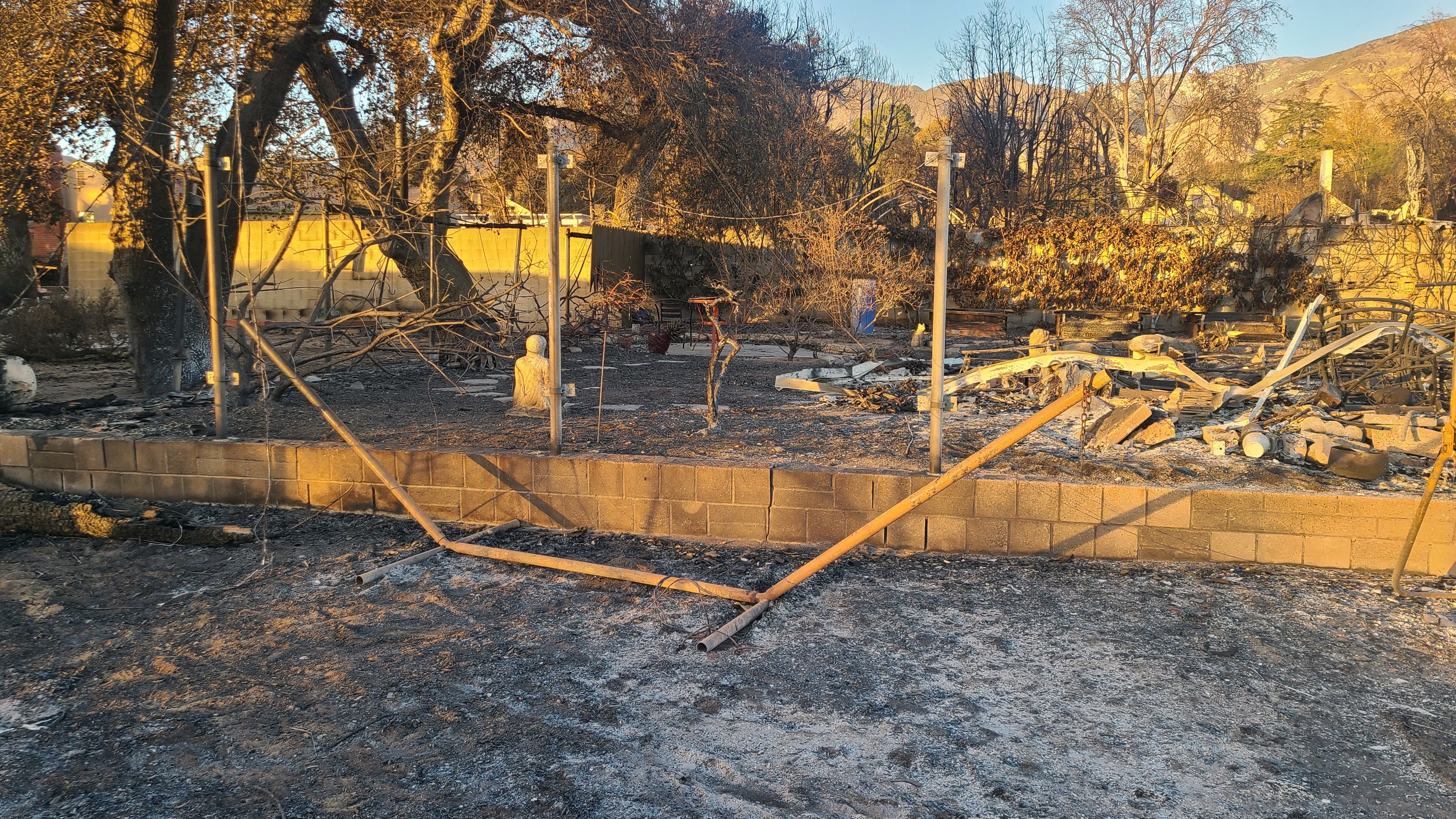
We probably shouldn’t have, but we walked the ground. Through the yard, up to the edge of the front porch, down the north side of the house, once nearly impassable due to rose bushes. We moved slowly, trying to take it all in – with no real urgency, because the clock had stopped ticking weeks ago. When it was time to go into the backyard, there was no need to open the gate to the back, the gate we’d prop open so the kids could ride their bikes or race their RC cars. We could just walk through the giant hole in it. It was a truly ugly sight. We saw dead and melted avocados on the grown, the skeletons of patio furniture, bits of glass and nails, and random crap too burned to identify.

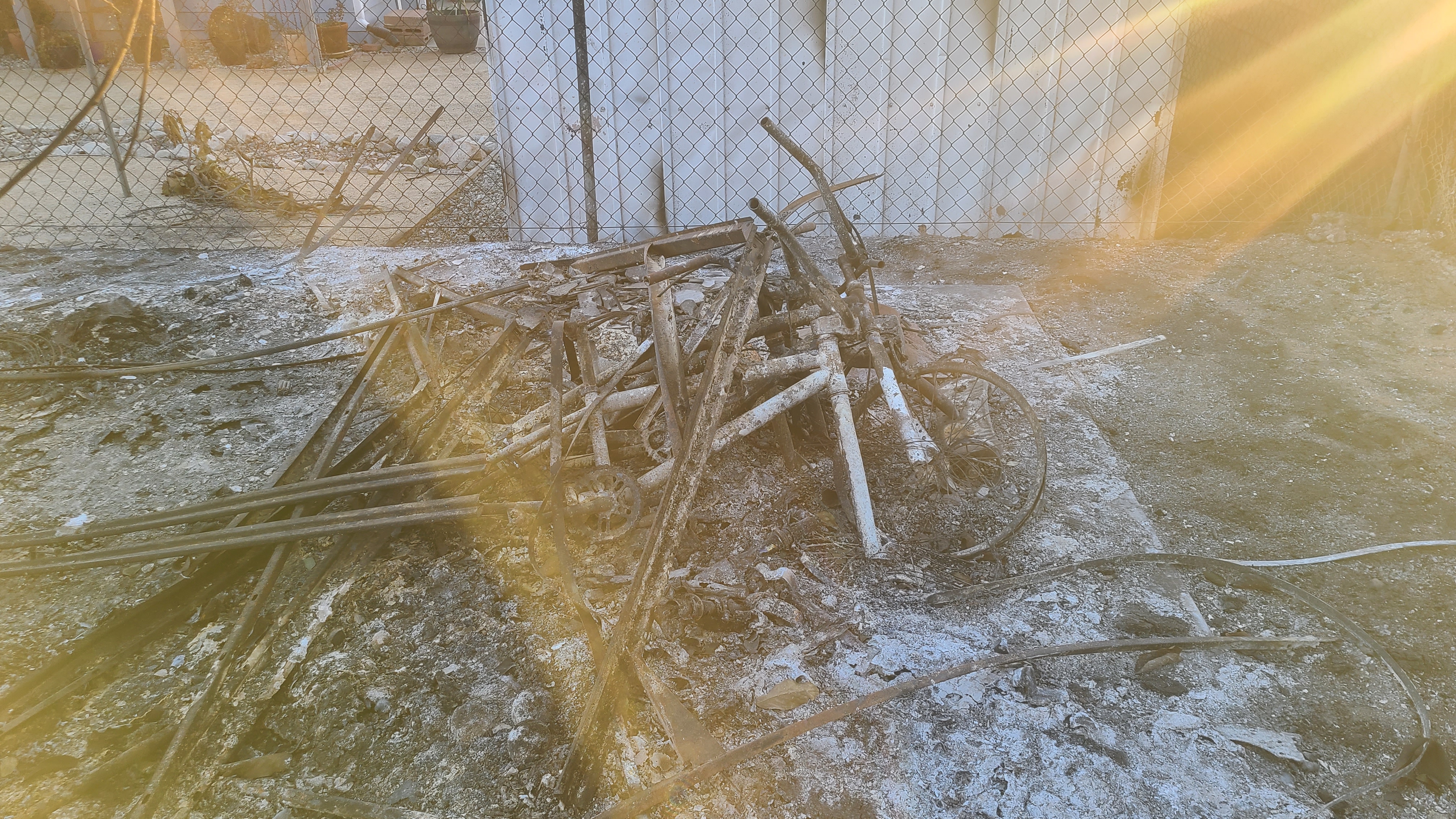
A few metal things could be identified, but not salvaged – the base for our Christmas tree stand, the skeleton of the hammock I got for my birthday one year that I used to lie in the early morning sun and listen to podcasts, the kids’ bikes.

Taking the advice of smarter people, we didn’t touch anything. That will likely happen today, Friday. It’s supposed to rain soon, and we want to get into the ruins and sift before it turns into sludge. So we got some free PPE from the County and the Red Cross, and will go play scavenger in our own stuff. I doubt we’ll find anything, but you never know. One neighbor found a Christmas ornament of ours that survived, a piece of Polish pottery that somehow made the trip from the attic to the burning ground without shattering. There have been some other nice stories about people finding wedding rings and inspirational signs and things. But it looks bad, and if we find anything, it’ll be a nice surprise.

It’s even more desolate at night, a neighborhood once bustling with families and love that’s now unlivable. No light, no movement, no people. The standing houses are yellow tagged – they were spared but not habitable for the moment. And it’s going to be that way for months, most likely. Nobody knows when the disaster abatement is going to start, when the wreckage will be removed, and when anyone is going to be able to even start rebuilding. Or how much it will cost, or who will have the financial capability to do it. It’s a complete mystery, and until it’s solved, all that will remain is the desolation.

When we got back, I wiped my house off my shoes and went inside.